

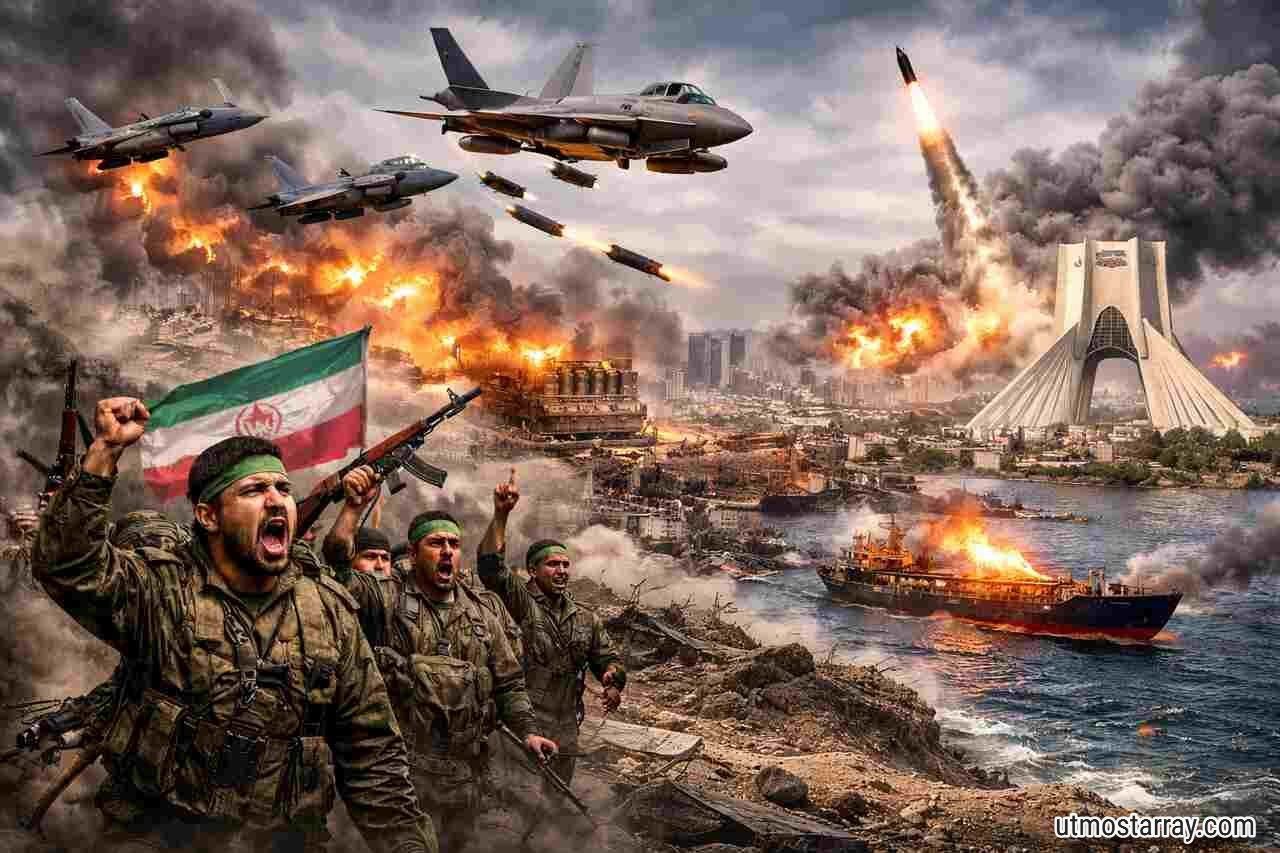
What might happen if the US attacks Iran? Look at these seven situations.
It looks like the US will attack Iran within days.
The possible targets are pretty easy to guess, but the result is not
What could happen if President Trump decides to attack and there isn’t a last-minute deal that can be made with Tehran?
1. Targeted, careful strikes with few innocent deaths and a move towards democracy
The US uses restricted, precise strikes against military bases of Iran’s Islamic Revolutionary Guards Corps (IRGC) and the Basij unit, which is a militia force controlled by the IRGC. The strikes also target Iran’s nuclear project and sites where ballistic missiles are launched and stored.
The government is overthrown, and Iran will finally become a real democracy and be able to join the rest of the world.
This is a very positive situation. When the West sent troops into Iraq and Libya, the shift to democracy was not easy. It stopped both of the cruel dictatorships, but it also started years of chaos and violence.
So far, things have gone better in Syria, which had its own revolution and got rid of President Bashar Al-Assad in 2024 without any help from the West.
2. Regime stays in power, but its policies become less harsh
This is what might be called the “Venezuelan model”: the US acts quickly and strongly, but its actions don’t change the government. Instead, they temper its policies.
In Iran’s case, this would mean that the Islamic Republic survived, which won’t make a lot of people happy. However, Iran would have to stop supporting violent militias across the Middle East, stop or slow down its nuclear and ballistic missile programmes, and stop or slow down its crackdown on protests.
This is once more at the less possible end of the scale.
For 47 years, the leaders of the Islamic Republic have been stubborn and unwilling to change. It doesn’t look like it can change direction right now.
3. The regime falls, and military power takes over
Many people think this is the most likely thing that will happen.
Many people clearly don’t like the government, and each wave of protests over the years has made it weaker. However, there is still a huge and widespread security deep state that wants things to stay the same.
The main reason the protests haven’t been able to overthrow the government yet is that there haven’t been many people who have switched sides, and those in power are ready to use any amount of violence and abuse to stay in power.
In the uncertainty of the aftermath of any US strikes it is possible that Iran ends up being run by a strong, military government made largely of IRGC figures.
4. Iran strikes back by striking US troops and its neighbours
That “its finger is on the trigger” means that Iran is ready to fight back if the US attacks.
Even though it isn’t as strong as the US Navy and Air Force, it could still strike back with its arsenal of ballistic missiles and drones, many of which are hidden in caves, underground, or on the sides of remote mountains.
Along the Arabian side of the Gulf, there are a number of US bases and facilities, most notably in Bahrain and Qatar. However, Iran could also attack any country it thought was helping the US attack, such as Jordan, and damage some of their important infrastructure.
The 2019 attack on Saudi Aramco’s petrochemical sites by missiles and drones, which was blamed on an Iranian-backed group in Iraq, made the Saudis realise how easy it was for Iran to fire missiles at them.
All of Iran’s Gulf Arab neighbours are US friends, so it makes sense that they are very worried that any US military action will backfire on them.
5. Iran responds by putting bombs in the Gulf
During the Iran-Iraq war (1980–1988), Iran did mine the shipping lanes, and Royal Navy minesweepers helped clear them. This has been seen as a possible threat to world shipping and oil sources ever since.
A very important chokepoint is the Strait of Hormuz, which is between Iran and Oman. It is through this strait that about 20% of the world’s LNG exports and 20–25% of its oil and oil waste go every year.
Iran has done practice with quickly setting up sea mines. It would have an effect on world trade and oil prices if it did that.
6. In response, Iran sinks a US warship
In the Gulf, a US Navy Captain once told me that a “swarm attack” from Iran is one of the things that worries him the most.
At this point, Iran fires so many high-explosive drones and fast torpedo boats at one or more targets that the US Navy’s strong close-in weapons can’t stop them all in time.
There used to be a regular Iranian Navy in the Gulf, but now there is only the IRGC Navy. Some of its leaders were trained at Dartmouth during the Shah’s reign.
A lot of Iran’s navy troops’ training has been in unconventional or “asymmetric” fighting. They have been looking for ways to get around the technical benefits that their main enemy, the US Navy’s Fifth Fleet, has.
It would be very embarrassing for the US if a warship it was sending out was sunk and its crew members were captured.
There was a suicide attack by Al-Qaeda on the USS Cole in Aden harbour in 2000 that damaged and killed 17 US soldiers. This situation is not likely to happen.
Before that, in 1987, an Iraqi jet pilot killed 37 soldiers when he accidentally shot two Exocet missiles at a US warship, the USS Stark.
7. The regime falls, and chaos takes its place
This is a real threat, and it’s one of the main things that neighbours Dubai and Qatar are worried about.
In addition to the chance of a civil war like the ones in Syria, Yemen, and Libya, there is also the chance that ethnic tensions could escalate into armed conflict as Kurds, Baluchis, and other minorities try to protect their own people while the government is not in charge.
A lot of people in the Middle East would love to see the Islamic Republic go. Israel, which has already given heavy blows to Iran’s allies in the area, worries that Iran’s suspected nuclear project could destroy it.
But no one wants to see the Middle East’s biggest country by population (about 93 million people) fall into chaos, which would lead to a humanitarian and refugee problem.
Now, the biggest risk is that President Trump, who has built up this huge force close to Iran’s borders, thinks he has to do something or lose face, and a war starts with no clear end goal and consequences that are hard to predict and could be harmful.
