

Introduction to the Investment Casting Method
Investment casting is a well-known manufacturing process used to create precise metal components. The method has been used for many years and remains important in modern engineering. It allows manufacturers to produce complex shapes with good accuracy and surface quality. Many industries, including aerospace, automotive, and medical equipment production, rely on this process.
The basic idea behind investment casting is simple. A pattern is created in wax that represents the final component. This wax pattern is then covered with ceramic material to form a mould. Once the mould becomes strong enough, the wax is melted away. Molten metal is poured into the empty cavity and allowed to cool. The result is a solid metal component that closely matches the original design.
Because the mould captures very fine details, the finished parts often require little additional machining. This improves production efficiency and reduces material waste. Manufacturers and engineering specialists such as Texmo Blank often use this method to produce components that require both precision and durability.
Creating the Wax Pattern
The first stage in the investment casting process involves producing a wax pattern. This pattern is an exact replica of the component that will eventually be made from metal. Wax is used because it can easily be shaped into detailed forms and later removed without damaging the mould.
Patterns are often produced using metal dies that shape the wax under controlled pressure. This helps maintain consistent size and detail for each pattern. In many cases, several wax patterns are produced at the same time. These patterns are then attached to a central wax structure known as a runner or tree. This arrangement allows multiple components to be cast during one production cycle.
Accuracy at this stage is very important. Any imperfection in the wax pattern may appear in the final metal component. For this reason, the patterns are carefully inspected before moving to the next stage. Once the wax assembly is complete, it is ready for the ceramic coating process that will create the mould.
Building the Ceramic Shell Mould
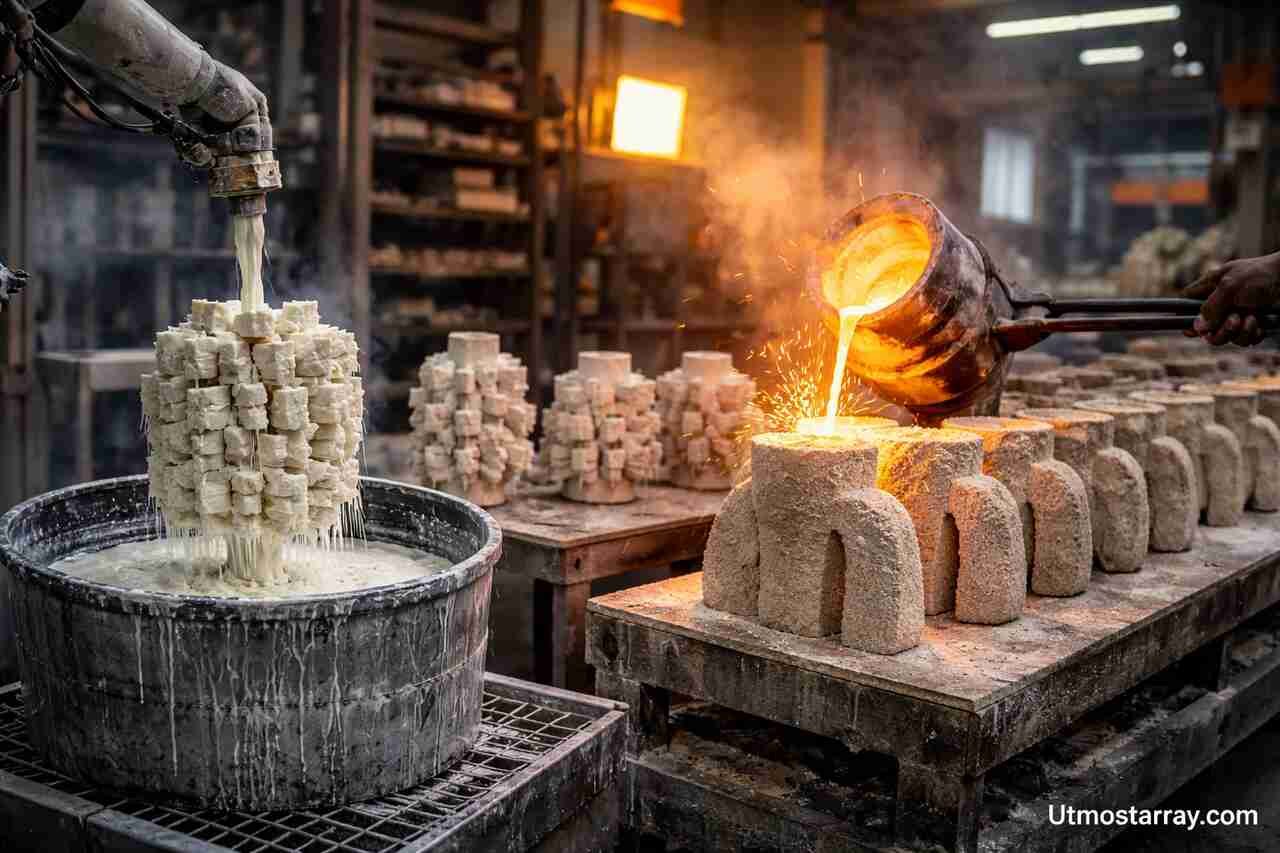
After the wax pattern assembly is prepared, the next step is to create the ceramic mould. This mould must be strong enough to hold molten metal while maintaining the shape of the component. The wax assembly is dipped into a liquid ceramic mixture known as slurry. After dipping, it is coated with fine sand or ceramic particles.
The assembly is then left to dry. This coating process is repeated several times to build a thick and durable ceramic shell. Each layer adds strength and stability to the mould. Once the shell reaches the required thickness, it becomes capable of handling the high temperatures involved in metal casting.
This stage plays an important role in achieving a smooth surface finish. The ceramic shell captures the small details of the wax pattern. As a result, the final metal part often has clean edges and smooth surfaces. This level of accuracy is one reason why investment casting is widely used when producing detailed components.
Removing the Wax and Pouring the Metal
Once the ceramic shell is fully formed and dried, the wax inside the mould must be removed. This step is known as dewaxing. The ceramic mould is heated so that the wax melts and drains away. What remains is a hollow cavity in the exact shape of the original pattern.
After dewaxing, the mould is heated again to strengthen it and prepare it for the casting stage. Preheating also ensures that the molten metal flows smoothly into all areas of the mould. When the mould reaches the correct temperature, molten metal is poured into the cavity.
Different metals may be used depending on the required properties of the final component. Stainless steel, aluminium alloys, and carbon steel are commonly used materials. The metal fills the cavity and gradually cools and solidifies inside the ceramic shell.
Finishing and Inspecting the Final Component
The final stage of the investment casting process begins after the metal has cooled. The ceramic shell is carefully broken away to reveal the cast metal components. Because several parts are often attached to the runner system, they are separated from the central structure.
At this stage, minor finishing processes may take place. These may include trimming excess metal, smoothing small areas, or performing light machining if needed. However, investment casting usually produces parts very close to their final shape. This means that extensive finishing work is rarely required.
Quality inspection is also an important step. Each component is checked to ensure that it meets the required specifications and standards. Measurements, surface quality, and structural integrity are carefully reviewed. These inspections help ensure that the finished parts are reliable and suitable for their intended applications.
Through this step-by-step process, investment casting produces detailed metal components with consistent quality. Its combination of precision, efficiency, and material flexibility makes it a valuable manufacturing technique used across many modern industries.
