

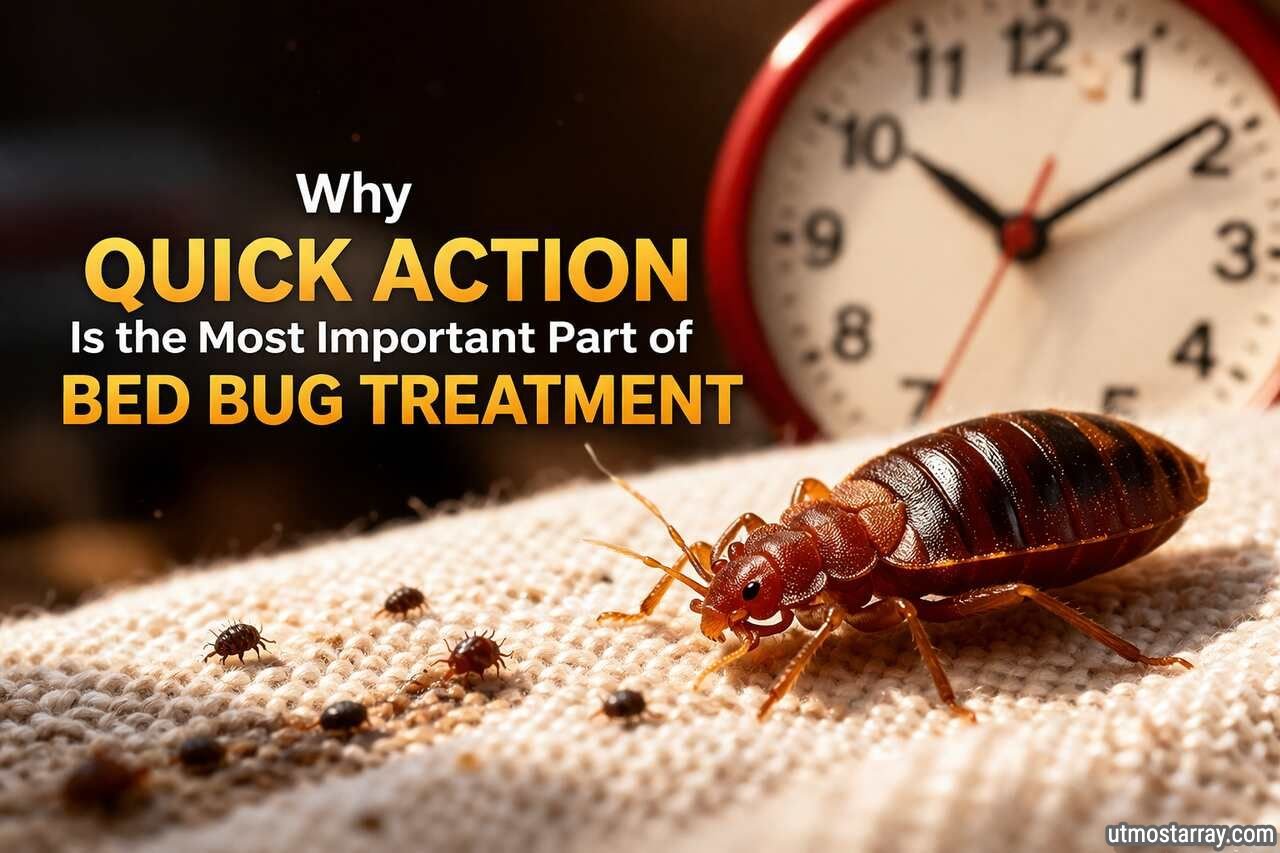
Bed bugs don’t telegraph their arrival. By the time most people spot one, there’s already a population hidden in mattress seams, baseboards, and furniture joints that’s been feeding for weeks. That gap between arrival and detection is exactly what makes a slow response so costly.
Why two weeks changes everything
_Cimex lectularius_ – the common bed bug – reproduces faster than most people realize. A single fertile female can lay up to 500 eggs in her lifetime, depositing them in small batches across dozens of harborage sites. At room temperature, a bed bug population can double every 13 days if a blood meal is present. That’s not a slow creep. That’s an exponential problem.
The egg-to-adult life cycle runs anywhere from five to ten weeks depending on temperature and food access. Each nymph passes through five molting stages before reaching reproductive maturity – a process called hemimetabolous metamorphosis. Missing even one life stage during treatment means survivors will repopulate. This is why a two-week delay doesn’t just make the problem slightly worse. It can turn a single-room issue into an infestation across multiple rooms, because bed bugs use pheromone signaling to congregate, and those colonies don’t stay put.
DIY approaches make it worse, not better
Hardware store sprays use pyrethroid as a base and many bed bug populations have developed resistance to these. It also is not possible to spray a mattress (or a baseboard) and penetrate the deep void structures where bed bugs will be living the vast majority of their lives. All spraying a mattress will do is scatter the colony. When disturbed bed bugs move. They push deeper into wall cavities, migrate to adjacent rooms, or take a ride on clothing or luggage to spread elsewhere in the building. This cross-contamination is how single-unit problems become whole-floor problems. The “wait and see” approach, typically accompanied by a trip to the hardware store, is one of the more reliable ways to assure that a more aggressive intervention will be necessary later.
Acting in the first week keeps the problem contained. Waiting until it’s undeniable means the treatment scope, and the cost, grow with every passing day.
The pre-treatment window matters more than the treatment itself
There’s a narrow window early in an infestation where options are still straightforward. Catch it there, and it’s possible to address the problem without replacing furniture, discarding mattresses, or treating adjacent units. Wait past that window, and none of those things can be avoided.
Professional Integrated Pest Management (IPM) approaches work by combining monitoring, targeted treatment, and structural inspection. The goal isn’t just to kill what’s visible – it’s to map every harborage site and close them off so no population survives to rebound. But that kind of precision is only possible when the colony is still localized. A dispersed infestation across multiple rooms requires a far more resource-intensive approach, which is why bed bug heat treatment works best when applied early.
Why heat is the only complete solution
Chemical treatments, no matter how professional-grade they might be, are well-documented as weak or completely ineffective against eggs. The basic science is simple: a bed bug egg’s cuticle, which is analogous to an adult’s thick exoskeleton, insulates and protects the developing insect inside from whatever is happening on the outside. It’s a natural reservoir of protein and water, and the insect would literally cook if it couldn’t resist to some degree the heat or chemicals being applied around it.
But it’s also why heat can be so effective when properly applied: the thin eggshell isn’t much of a barrier at all, and the warm and dry conditions bed bugs need to grow into adults is the exact thing that makes the egg vulnerable to desiccation and death. Just a few hours in the temperature band of 113°F to 122°F – the thermal death point for all bed bug life stages – is enough to kill everything, eggs included. There’s no need to wrangle chemical resistance or develop an alternate formula.
Desiccation-based treatments like silica dusts can complement heat in hard-to-reach areas, but they work slowly and don’t address eggs effectively either. Heat remains the only method that provides a complete solution in a single intervention.
The psychological cost of waiting
The most obvious consequence of delay is the physical symptoms of bites – itching and resultant secondary skin infections from excessive scratching are the last thing you need on top of everything else. Loss of sleep is another common secondary symptom – and it can be a vicious cycle, as the stress and anxiety from the infestation can make it harder to sleep, and lost sleep makes it more difficult to manage stress and anxiety.
Many people report recurrent nightmares or outright night terrors about being bitten that wake them up in the night (and not always incorrectly). A high degree of hypochondria is also common, with others developing a ‘phantom biting’ syndrome that convinces them they are still being bitten well after the infestation is cleared. People often develop heightened or irrational fears of a number of things, most often a fear of what’s under the furniture, but also of desks, clothing, clutter in general, pets, their car, etc.
The longer an infestation runs, the longer recovery takes – not just in terms of treatment, but in terms of returning to normal sleep and daily comfort.
Bed bugs aren’t like most household pests where a week’s delay costs nothing. They’re a biological clock that runs against you from the moment they arrive. The window to contain the problem without major disruption is real, and it’s shorter than most people expect.
