

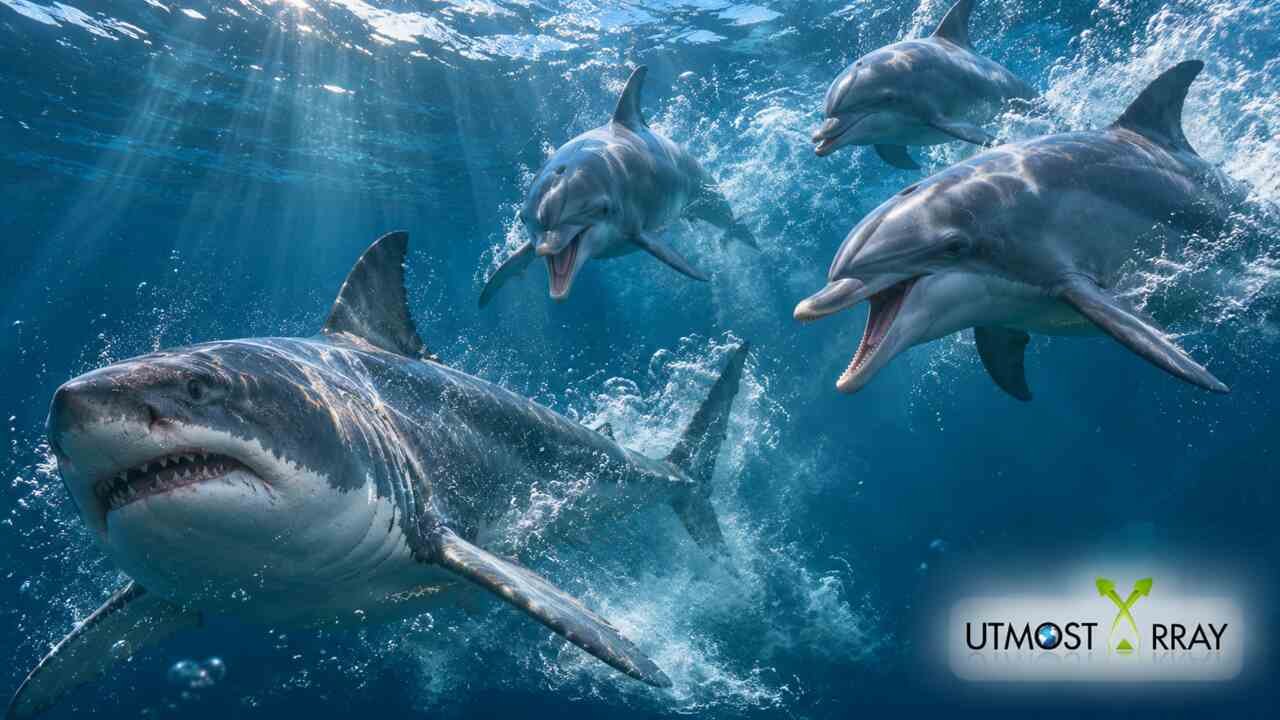
Sharks may avoid dolphins when confronted by a defensive pod, but they are not universally afraid of them. Dolphins use cooperative behavior, powerful body strikes, and maneuverability to defend themselves. However, large sharks, including great white, tiger, and bull sharks, can also prey on dolphins.
Killer whales, the largest members of the dolphin family, are a notable exception. Scientific studies show that even great white sharks abandon established feeding grounds when orcas appear. The relationship depends on the species, group size, physical strength, and circumstances of the encounter.
Why Are Sharks Afraid of Dolphins in Certain Situations?
Sharks may retreat from dolphins when attacking them carries a significant risk of injury. Dolphins can defend themselves individually or collectively, making some encounters more dangerous for an approaching predator.
Dolphins Defend Themselves in Groups
Dolphins frequently travel in social groups called pods. When a shark threatens the group, dolphins may cooperate to chase it away or protect vulnerable members.
Research published in Marine Mammal Science describes an encounter in Southern California where 14 adult bottlenose dolphins collectively confronted and drove away a white shark. This behavior is known as mobbing, where animals collectively confront a potential predator.
However, group defense is not always successful, and dolphins may choose to escape rather than confront a large shark.
Dolphins Use Powerful Snouts and Body Strikes
Dolphins can use their muscular bodies and strong snouts to ram threatening sharks. They may also deliver forceful strikes using their tail flukes.
These defensive capabilities may discourage an attack, particularly when several dolphins participate. However, physical confrontations also expose dolphins to potentially serious injuries.
There is insufficient evidence to suggest that ordinary dolphins routinely kill large sharks using these techniques.
Echolocation and Underwater Awareness
Dolphins use echolocation by producing high-frequency clicks and interpreting returning echoes. This ability helps them locate prey, navigate underwater, and detect objects in their surroundings.
According to NOAA Fisheries’ bottlenose dolphin species profile, dolphins use sound for communication and finding food.
Combined with advanced hearing and social communication, echolocation supports environmental awareness. However, it does not make dolphins immune to surprise attacks from sharks.
Do Sharks Attack and Eat Dolphins?
Yes, several large shark species prey on dolphins. Young calves, isolated individuals, and physically weakened dolphins may be particularly vulnerable under certain circumstances.
The Sarasota Dolphin Research Program in Florida has identified tiger sharks and bull sharks as frequent shark predators of its resident dolphin population. Researchers document shark-inflicted wounds during photographic identification surveys to understand predation pressure.
Which Shark Species Pose a Threat to Dolphins?
| Shark Species | Scientific Name | Relationship With Dolphins |
| Great white shark | Carcharodon carcharias | Can prey on dolphins and other marine mammals |
| Tiger shark | Galeocerdo cuvier | Significant predator of dolphins in some coastal ecosystems |
| Bull shark | Carcharhinus leucas | Known predator of dolphins in coastal waters |
| Nurse shark | Ginglymostoma cirratum | Generally feeds on smaller marine animals and may forage alongside dolphins |
| Whale shark | Rhincodon typus | Filter feeder that does not hunt dolphins |
The presence of a shark does not automatically indicate danger to a dolphin. Feeding habits, body size, and hunting behavior differ considerably between shark species.
Scientific Evidence of Shark Attacks on Dolphins
Research involving wild dolphin populations provides clear evidence that sharks are genuine predators rather than animals that consistently avoid dolphins.
A 2018 study of Australian bottlenose dolphins identified shark-inflicted bites or scars on 58 of 343 individuals.
Similarly, a 2026 study conducted in Biscayne Bay, Florida documented definitive shark-inflicted injuries on 69 of 320 bottlenose dolphins.
| Study Location | Publication Year | Dolphins Examined | Dolphins With Shark Injuries |
| Southwestern Australia | 2018 | 343 | 58 (16.9%) |
| Biscayne Bay, Florida | 2026 | 320 | 69 (21.6%) |
However, visible bite wounds and scars primarily reveal encounters that dolphins survived. They cannot establish the total number of fatal attacks or predict the likelihood of an attack during an individual encounter.
Shark vs. Dolphin: Which Animal Has the Advantage?
Large predatory sharks generally possess a physical advantage over individual bottlenose dolphins. Dolphins, meanwhile, can benefit from maneuverability, cooperation, and collective defensive behavior.
| Characteristics | Sharks | Dolphins |
| Classification | Cartilaginous fish | Marine mammals |
| Primary physical weapons | Jaws and teeth | Body strikes, teeth, and tail flukes |
| Specialized senses | Electroreception and smell | Echolocation and advanced hearing |
| Social behavior | Varies by species | Frequently live in social groups |
| Swimming movement | Horizontal tail movement | Vertical tail movement |
| Defensive advantages | Physical size and strength in larger species | Agility and group cooperation |
| Hunting strategies | Ambush and active pursuit, depending on species | Individual and cooperative hunting |
Who Would Win in a Fight Between a Shark and a Dolphin?
A large great white shark could overpower an individual bottlenose dolphin, particularly during a surprise attack. A group of dolphins confronting a smaller shark may have a defensive advantage.
An orca, however, represents a very different situation. Its physical size and ability to hunt large marine predators make it capable of killing sharks.
The outcome of an encounter cannot be determined without considering the species, size, number of animals, and environmental conditions.
Are Great White Sharks Afraid of Killer Whales?
Great white sharks exhibit documented avoidance behavior when killer whales enter certain feeding grounds. Orcas belong to the oceanic dolphin family, Delphinidae, and some populations actively prey on sharks.
Unlike claims about ordinary dolphins consistently frightening sharks, the avoidance response involving great white sharks and orcas is supported by tracking data and direct observations.
Scientific Evidence From California
A 2019 study published in Scientific Reports examined interactions between killer whales and great white sharks near the Southeast Farallon Islands off California.
During one particularly well-documented encounter in November 2009, 17 previously tagged white sharks were present when killer whales entered the area. Although the orcas remained for only a few hours, the sharks departed their feeding grounds.
Researchers also found that shark departures reduced predation pressure on elephant seals. This illustrates how the presence of a larger predator can influence the behavior of other predators and affect the wider marine ecosystem.
Why Do Orcas Hunt Sharks?
Some orcas hunt sharks specifically for their energy-rich livers. The high lipid content of shark livers provides a valuable food source.
A 2024 study published in the African Journal of Marine Science documented an adult male orca killing a juvenile great white shark and consuming its liver in Mossel Bay, South Africa.
The attack lasted less than two minutes, demonstrating that an individual orca can overpower a suitably sized white shark without assistance.
However, shark hunting is not common to every orca population. Feeding preferences vary considerably according to location and learned hunting behavior.
Can Dolphins and Sharks Swim Together?
Yes, dolphins and sharks can share the same habitat and sometimes feed alongside one another. Their interactions are not always aggressive because both animals may benefit from areas containing abundant prey.
Sharks and dolphins may interact through predation, defensive behavior, competition for food, or shared foraging opportunities.
A Documented Example of Shared Foraging
A 2022 study published in Animal Biotelemetry recorded a nurse shark following bottlenose dolphins for approximately 15 minutes in the Florida Keys.
Researchers observed the shark moving through sediment disturbed by feeding dolphins, apparently searching for exposed prey.
The dolphins struck the shark three times with their tail flukes, but it continued following the group. This encounter demonstrates that proximity to dolphins, even when accompanied by physical contact, does not necessarily cause a shark to retreat.
Are Dolphins Afraid of Sharks?
Dolphins exhibit predator-avoidance behavior when dangerous sharks are present. They may change their feeding locations, form larger groups, or avoid habitats associated with an increased risk of attack.
According to research on tiger shark predation and dolphin habitat use conducted in Shark Bay, Western Australia, bottlenose dolphins reduced their use of productive shallow waters when tiger sharks were abundant.
Dolphin groups were also larger in these relatively dangerous environments. These findings show that sharks can influence dolphin behavior without necessarily attacking them.
How Dolphins Protect Their Calves
Adult dolphins may cooperate to protect young or injured members of their groups. Calves often remain close to their mothers, benefiting from physical proximity and reduced swimming effort.
Collective defense can help discourage predators, but it cannot eliminate the risk of an attack.
Why Dolphins Avoid Unnecessary Confrontations
Fighting a large shark exposes dolphins to potentially serious injuries. Avoiding dangerous habitats or escaping from an approaching predator may offer better survival prospects than engaging in physical combat.
This explains why dolphins can display aggressive defensive behavior in one situation while avoiding sharks in another.
Do Dolphins Protect Humans From Sharks?
There are reports of dolphins surrounding swimmers or confronting nearby sharks. However, scientific evidence does not establish that wild dolphins reliably or intentionally protect humans from shark attacks.
A dolphin’s behavior may reflect its response to a perceived threat, protection of its own group, or other social activities. Determining the animal’s motivation from an isolated encounter is difficult.
Is It Safe to Swim When Dolphins Are Nearby?
The presence of dolphins does not mean sharks are absent. Both animals may be attracted to the same schools of fish and productive feeding grounds.
Whether you are visiting Florida’s coastline or planning a summer vacation involving swimming and snorkeling, following established ocean safety practices is more reliable than using dolphin sightings to judge whether the water is safe.
The Florida Museum’s International Shark Attack File safety guidelines recommend the following precautions:
- Swim with a companion in designated swimming areas.
- Avoid swimming near anglers or feeding marine animals.
- Stay away from dense schools of baitfish.
- Exercise additional caution in murky water.
- Avoid swimming at dawn, dusk, or night.
- Move slowly away and exit the water if a shark approaches.
NOAA Fisheries also recommends observing wild dolphins from at least 50 yards away, subject to applicable local rules, and avoiding activities such as feeding, touching, or deliberately swimming with them.
Travelers interested in observing marine wildlife can explore ethical and sustainable ways to travel without unnecessarily disturbing animals in their natural habitats.
Common Myths About Sharks and Dolphins
| Myth | Scientific Reality |
| All sharks are afraid of dolphins. | Avoidance depends on the species and circumstances. |
| Sharks never eat dolphins. | Several large shark species prey on dolphins. |
| Dolphins always win against sharks. | Dolphins can suffer serious or fatal shark injuries. |
| Dolphin sounds naturally repel sharks. | No convincing evidence establishes ordinary dolphin sounds as a reliable shark deterrent. |
| Sharks and dolphins cannot coexist. | Both animals can share habitats and feeding grounds. |
| Dolphins always protect humans from sharks. | Consistent protective behavior toward humans has not been scientifically established. |
| Great white sharks have no natural predators. | Certain orcas actively hunt great white sharks. |
Conclusion
The belief that sharks are afraid of dolphins contains some truth, but it oversimplifies a complex predator-prey relationship. Bottlenose dolphins can collectively defend themselves against sharks, while orcas can cause even great white sharks to abandon their feeding grounds.
The most scientifically accurate explanation is that both sharks and dolphins adjust their behavior in response to potential threats, feeding opportunities, and survival risks. Neither animal is universally dominant in every encounter.
FAQs
Can dolphins kill sharks?
Ordinary dolphins can potentially injure or kill sharks through physical strikes, although documented fatal encounters are limited. Orcas are known to actively hunt and kill certain shark species.
Are sharks afraid of dolphin sounds?
There is no convincing scientific evidence that ordinary dolphin vocalizations consistently frighten or repel sharks. A shark’s response depends on its sensory environment and the nature of the perceived threat.
Are dolphins faster than sharks?
Swimming speeds vary by species and activity. Some dolphins are effective at rapid acceleration and maneuvering, while certain predatory sharks can achieve considerable speeds during short hunting bursts.
Do dolphins eat small sharks?
Some members of the dolphin family, particularly shark-hunting orcas, consume sharks. Common bottlenose dolphins typically feed on fish, squid, and crustaceans rather than sharks.
Do sharks attack dolphins at night?
Sharks can attack dolphins during both daytime and nighttime. Hunting activity varies according to the shark species, prey availability, habitat, and environmental conditions.
