

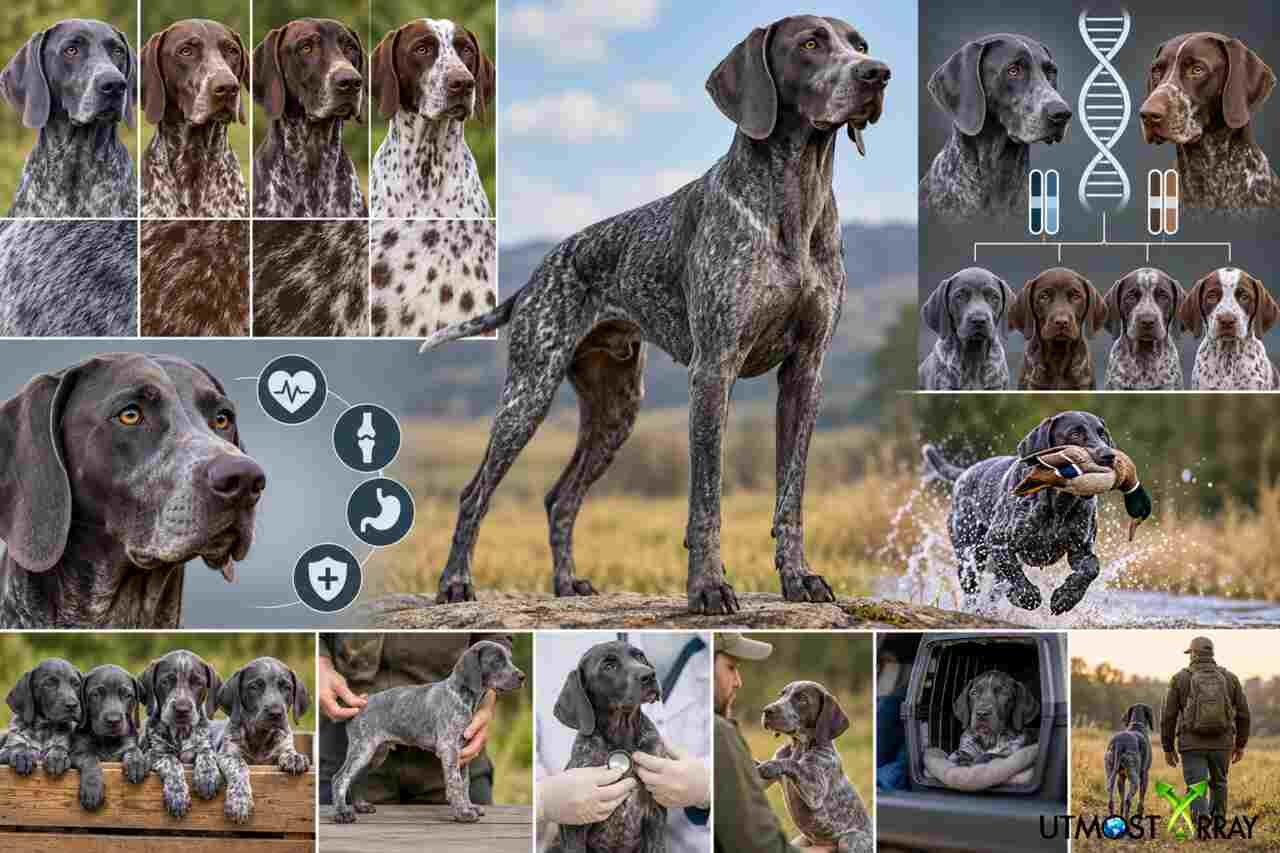
A blue German Shorthaired Pointer (GSP) is a dog with a beautiful blue-gray or silver-gray coat that makes it stand out from other German Shorthaired Pointers. Although blue isn’t an officially recognized breed color, some GSPs naturally have this appearance.
What Is a Blue German Shorthaired Pointer?
A blue German Shorthaired Pointer is not a separate dog breed or an officially recognized variety. The name is commonly used to describe a GSP whose coat appears gray, silver, or bluish instead of the more familiar liver-and-white combination.
There are two main reasons for this appearance.
The first is black roan coloring, where black and white hairs grow closely together, producing a blue-gray effect. This is a recognized coat pattern within the breed.
The second is genetic color dilution, which lightens dark pigmentation. A German Shorthaired Pointer with diluted black pigment may have a slate-gray or steel-blue appearance rather than a deep black coat.
Although these dogs may look similar, their coat genetics are different.
A black roan German Shorthaired Pointer can meet the breed’s recognized color requirements. A genuinely diluted blue GSP falls outside the standard coat colors used in conformation judging.
The distinction becomes particularly important when breeders advertise puppies as rare blue German Shorthaired Pointers.
Why Do Some German Shorthaired Pointers Look Blue?
The blue appearance in German Shorthaired Pointers generally results from either roan coloring or inherited pigment dilution.
Understanding these two mechanisms helps explain why a dog may look blue without possessing the genes normally responsible for a diluted coat.
Black Roan Coat Pattern
A black roan German Shorthaired Pointer has black and white hairs distributed together across portions of its body.
When viewed from a distance, these hairs blend visually, creating a gray or blue-gray appearance.
A black roan GSP may have:
- A predominantly black head
- Black patches across the body
- Gray-looking areas formed by mixed black and white hairs
- Small spots or ticking on lighter areas
- A short, dense, smooth coat
The amount of black and white varies between individual dogs.
Some black roan GSPs look almost entirely black from a distance, while others appear noticeably silver-gray.
However, their underlying black pigment has not necessarily been diluted.
Genetically Diluted Blue Coloring
True blue coloring generally occurs when inherited genetic variants reduce the intensity of black pigmentation.
Instead of producing a deep black appearance, affected pigment may look charcoal-gray, slate-blue, or silver-gray.
The diluted coloring can extend beyond the fur to the nose and other pigmented areas of the body.
Unlike roaning, which creates a blended appearance through the distribution of pigmented and white hairs, genetic dilution changes the appearance of the dark pigment itself.
A dog may also inherit multiple coat-color characteristics, meaning dilution and patterned coloring are not necessarily mutually exclusive.
Blue Roan vs. Genetically Blue German Shorthaired Pointer
| Feature | Black Roan GSP | Genetically Diluted Blue GSP |
| Coat appearance | Black and white hairs creating a gray-blue effect | Dark pigment lightened to gray or blue |
| Genetic explanation | Roan coat pattern | Recessive pigment dilution |
| Nose pigmentation | Usually black | May appear slate-gray |
| Breed standard | Recognized | Nonstandard |
| Coat-health implications | No dilution-specific risk implied | Possible dilution-associated coat concerns |
| Identification | Coat inspection, ancestry, and markings | Genetic testing and pigment examination |
The most reliable way to distinguish the two is to examine the dog’s pigmentation, markings, ancestry, and relevant genetic test results.
A photograph alone may not provide enough information.
Is a Blue German Shorthaired Pointer Rare?
A genuinely diluted blue German Shorthaired Pointer is uncommon, but there are no reliable population-wide statistics establishing exactly how rare the color is.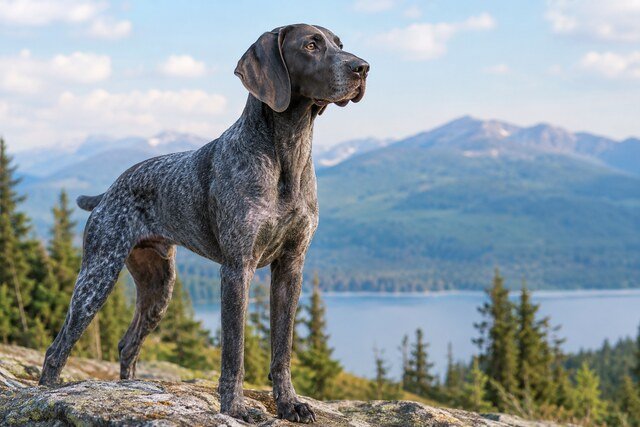
Black roan German Shorthaired Pointers are an established coat variety. Because some black roan dogs appear bluish-gray, they may occasionally be advertised as blue.
This can make the color seem rarer than it actually is.
It also creates confusion between an accepted breed color pattern and a nonstandard genetic dilution.
Does Rarity Make a Blue GSP More Valuable?
Not necessarily.
A rare coat appearance does not automatically indicate better genetics, higher intelligence, stronger hunting ability, or superior health.
A puppy’s value as a companion should depend primarily on responsible breeding, documented health testing, temperament, and suitability for its future home.
For example, imagine two puppies offered by different breeders.
One is advertised as an extremely rare blue GSP but has no documented parental health screenings. The other is a black roan puppy whose breeder provides verified health results, a pedigree, and detailed information about both parents.
The second puppy offers substantially more useful evidence about breeding quality, regardless of which color appears more unusual.
Buyers should therefore treat rarity claims as something to investigate rather than a reason to pay more.
Is Blue an Official German Shorthaired Pointer Color?
No. Genetically diluted blue is not an officially recognized coat color under the American Kennel Club’s German Shorthaired Pointer breed standard.
The standard recognizes liver and black pigmentation in several solid, white-combination, and roan patterns.
Recognized colors include:
- Solid liver
- Liver and white
- Liver roan
- White and liver
- Solid black
- Black and white
- Black roan
An important distinction is that black German Shorthaired Pointers are recognized under the current standard.
Historically, black coloration was treated differently in American conformation judging. The AKC’s revised breed standard, effective January 1, 2023, removed the former disqualification for black GSPs.
Therefore, a black roan GSP is not automatically disqualified simply because its coat appears dark or bluish-gray.
A genuinely diluted blue dog, however, does not match the recognized standard colors.
Can a Blue German Shorthaired Pointer Be Registered?
Registration and breed-standard eligibility are different matters.
A German Shorthaired Pointer may have documented purebred ancestry while displaying a coat color outside the standard.
Whether an individual dog can be registered, and how its color is recorded, depends on the registry’s rules and documentation requirements.
Breed registration does not necessarily mean that the dog meets every requirement for conformation showing.
Owners interested in dog shows should confirm the applicable breed standard and registration requirements before purchasing a puppy.
Blue German Shorthaired Pointer Genetics Explained
A dog’s coat color depends on inherited genes that influence pigment production, pigment distribution, and the intensity of coloration.
Two particularly relevant genetic locations are commonly called the B locus and D locus.
B Locus: Black and Liver Pigmentation
The B locus is associated with the TYRP1 gene, which influences whether a dog’s dark eumelanin pigment appears black or brown.
In simplified terms, dogs carrying at least one functional dominant black-pigment allele generally produce black eumelanin, assuming other genes permit its expression.
Dogs inheriting the relevant recessive brown variants from both parents express brown or liver pigmentation.
This helps explain why some German Shorthaired Pointers have black markings while others have liver-colored coats.
D Locus: Pigment Dilution
The D locus is associated with the MLPH gene.
Certain inherited variants can reduce the intensity of eumelanin pigmentation, making black appear gray or blue.
Dilution is generally inherited recessively, meaning a dog must receive compatible dilution variants from both parents to express the associated coat change.
A simplified inheritance model looks like this:
| Genotype | Expected Effect |
| D/D | No dilution associated with the variant |
| D/d | Carrier without visible dilution |
| d/d | Diluted pigment |
This example describes one recessive dilution variant. Actual genetic testing may involve multiple variants and requires interpretation according to the specific test.
Can Two Non-Blue GSPs Produce Blue Puppies?
Yes, under the right genetic circumstances.
If two dogs carry the same recessive dilution variant without visibly expressing it, they may produce a diluted puppy.
In a simplified D/d × D/d pairing, the theoretical probabilities for each puppy are:
- 25% chance of D/D
- 50% chance of D/d
- 25% chance of d/d
These percentages apply independently to every puppy. They do not guarantee that exactly one puppy in a four-puppy litter will have diluted coloring.
Genetic testing can help breeders and buyers understand how particular coat colors may have been inherited.
However, a color-DNA test does not replace comprehensive health screening.
Are Blue German Shorthaired Pointers Healthy?
A blue German Shorthaired Pointer can be healthy, but its coat appearance alone cannot establish whether it has inherited health risks.
A black roan dog that merely looks blue does not automatically carry the genetic characteristics associated with coat dilution.
For genuinely diluted dogs, one concern is color dilution alopecia.
Color Dilution Alopecia
Color dilution alopecia (CDA) is a hereditary coat condition associated with abnormal hair structure in some dogs with diluted pigmentation.
Affected dogs may develop progressive hair thinning or hair loss, particularly in diluted areas of the coat.
Possible symptoms include:
- Brittle or easily broken hair
- Patchy hair loss
- Dry or flaky skin
- Recurrent skin infections
- Poor coat quality
- Itching associated with secondary irritation
Symptoms may develop after a puppy initially appears to have a healthy coat.
However, not every genetically diluted dog develops color dilution alopecia.
The relationship between dilution genetics and coat disease varies among breeds and individual dogs. Reliable GSP-specific statistics are insufficient to predict the exact risk for a particular blue puppy.
A veterinarian should evaluate unexplained hair loss because parasites, allergies, infections, hormonal disorders, and other conditions can produce similar symptoms.
Other Common GSP Health Considerations
Regardless of color, German Shorthaired Pointers can be affected by inherited orthopedic, cardiac, and eye conditions.
Responsible breeders should use appropriate health screening to inform their breeding decisions.
| Health Screening | What It Evaluates |
| Hip evaluation | Hip dysplasia and joint development |
| Elbow evaluation | Elbow abnormalities |
| Cardiac examination | Certain heart abnormalities |
| Ophthalmologist examination | Hereditary eye conditions |
| Cone degeneration DNA test | An inherited retinal disorder affecting vision |
Buyers should request the actual results rather than accepting a general statement that the parents are healthy.
German Shorthaired Pointers can also develop gastric dilatation-volvulus, a serious emergency commonly associated with severe bloat.
Signs such as unsuccessful attempts to vomit, a swollen abdomen, severe distress, or collapse require immediate veterinary treatment.
Health screening improves breeding decisions but cannot guarantee a completely disease-free dog.
Blue German Shorthaired Pointer Size, Weight, and Lifespan
Blue German Shorthaired Pointers have the same general physical characteristics as other members of the breed.
Coat color does not create a larger, smaller, or fundamentally different type of GSP.
Typical adult measurements are:
| Characteristic | Male | Female |
| Height | 23–25 inches | 21–23 inches |
| Weight | 55–70 pounds | 45–60 pounds |
| Coat | Short and dense | Short and dense |
| Build | Athletic and muscular | Athletic and muscular |
The typical life expectancy of a German Shorthaired Pointer is approximately 10–12 years, although individual dogs may live shorter or longer lives.
Genetics, nutrition, veterinary care, body condition, exercise, and overall health influence longevity.
There is no established evidence that a blue-looking coat alone changes the breed’s normal adult size or lifespan.
Blue German Shorthaired Pointer Temperament and Personality
A blue German Shorthaired Pointer generally shares the same behavioral characteristics as other GSPs.
These dogs are intelligent, energetic, affectionate, and strongly motivated by activity.
Originally developed as versatile hunting companions, German Shorthaired Pointers were bred to locate game, point, track, and retrieve.
Those working instincts remain apparent in many modern family dogs.
Are They Good Family Dogs?
German Shorthaired Pointers can make excellent family companions when their activity needs are consistently met.
Many form strong bonds with their owners and enjoy being involved in household routines.
Their affectionate nature can make them rewarding companions for families that enjoy hiking, running, outdoor games, and other active pursuits.
However, their natural enthusiasm and strength mean interactions with young children should be supervised.
A lively GSP may unintentionally knock over a small child during play, particularly before it has learned appropriate manners.
Are They Good With Other Pets?
GSPs can live successfully with other dogs when appropriately socialized.
Compatibility with cats and smaller animals varies considerably.
Because the breed has a strong hunting background, some individuals display a pronounced prey drive.
Early introductions, supervision, management, and consistent training can improve household compatibility, but they cannot guarantee that every GSP will safely coexist with small pets.
Can They Be Left Alone?
German Shorthaired Pointers generally prefer regular interaction with their families.
Dogs that receive insufficient exercise, mental stimulation, or companionship may develop unwanted behaviors such as chewing, digging, excessive barking, or destructive activity.
Gradual independence training and a predictable routine can help a GSP become comfortable spending reasonable periods alone.
However, a high-energy GSP is usually not the best choice for someone who wants a dog that remains inactive for most of the day.
Exercise Requirements for a Blue German Shorthaired Pointer
German Shorthaired Pointers require substantial physical and mental activity.
Their athletic build and working background make them especially suitable for owners who enjoy regular outdoor exercise.
Healthy adult GSPs often benefit from around one to two hours of daily activity, depending on their age, conditioning, temperament, and individual needs.
This is a practical guideline rather than a fixed requirement for every dog.
Physical exercise should be combined with mental enrichment because running alone may not fully satisfy an intelligent hunting breed.
Suitable activities include:
- Long walks and outdoor exploration
- Fetch and retrieving games
- Hiking on appropriate trails
- Swimming
- Scent work and tracking
- Obedience training
- Agility and other dog sports
- Supervised off-leash exercise in secure areas
A Practical Daily Routine
For example, a healthy, physically conditioned adult GSP might follow this routine:
Morning: A 40-minute brisk walk or outdoor exercise session, followed by a short obedience practice.
Afternoon: A 15-minute scent-search activity or interactive training game.
Evening: A 30- to 45-minute walk, retrieving session, or other appropriate physical activity.
The routine should be adjusted according to the dog’s health, fitness, temperature, and daily workload.
Puppies require shorter, age-appropriate activity sessions. Forced long-distance running, repetitive jumping, and excessive high-impact exercise should be avoided while their bodies are developing.
Training a Blue German Shorthaired Pointer
German Shorthaired Pointers are intelligent and generally responsive to consistent, reward-based training.
Their enthusiasm can make them quick learners, but their curiosity and hunting instincts may also distract them.
Training should begin early and progress through practical, achievable steps.
Establish Basic Obedience
Start with everyday commands such as sit, stay, come, leave it, and loose-leash walking.
Use food rewards, toys, praise, and short training sessions to reinforce desirable behavior.
Consistency matters more than repeatedly practicing commands for extended periods.
Focus on Recall
Reliable recall is especially valuable for German Shorthaired Pointers because they may become intensely interested in birds, squirrels, and other wildlife.
Practice in controlled environments before introducing more distracting outdoor locations.
A long training line can provide additional safety while recall skills develop.
Do not assume that a dog with good recall in the backyard will respond equally well when pursuing wildlife.
Provide Mental Challenges
Puzzle feeders, scent games, retrieving tasks, and structured training activities help keep the dog’s mind occupied.
These activities are particularly useful during bad weather or when physical exercise needs to be temporarily reduced.
Training should build confidence and cooperation rather than relying on fear or harsh punishment.
Grooming and Coat Care
German Shorthaired Pointers have short, dense coats that are relatively easy to maintain.
Regular grooming removes loose hair, helps distribute natural skin oils, and provides an opportunity to notice skin changes.
Brushing and Bathing
Brush the coat several times a week using a rubber grooming mitt or a suitable soft brush.
GSPs shed, and shedding may become more noticeable during seasonal changes.
Bathe the dog when necessary using an appropriate dog shampoo. Excessive bathing or irritating grooming products may contribute to skin dryness.
Ear and Nail Care
Inspect the ears regularly, particularly after swimming or outdoor activities.
Keep nails at an appropriate length and monitor the paws for cuts, irritation, or foreign material.
Routine dental care also supports overall health.
Special Care for Genetically Diluted Coats
A genetically diluted GSP does not automatically require special grooming products.
However, owners should monitor for hair thinning, persistent flaking, or unusual skin sensitivity.
If problems develop, a veterinarian can recommend appropriate diagnostic tests and treatment.
Do not assume that every skin issue is caused by coat dilution.
How Much Does a Blue German Shorthaired Pointer Cost?
There is no dependable universal price for blue German Shorthaired Pointer puppies.
Prices vary according to location, breeder reputation, health screening, pedigree, working lines, availability, and market demand.
Some breeders may advertise blue puppies at higher prices because of their unusual appearance.
However, a premium price does not prove that a dog is healthier, rarer, or better bred.
Costs Beyond the Puppy Price
The initial purchase is only one part of dog ownership.
A prospective owner should also budget for:
- Veterinary examinations and preventive care
- Vaccinations and parasite prevention
- Quality dog food
- Training classes
- Crates, bedding, collars, and harnesses
- Grooming supplies
- Emergency veterinary expenses
- Pet insurance, if desired
Large, active breeds can also generate additional costs through training, equipment, boarding, and participation in sporting activities.
Before purchasing a puppy, calculate whether ongoing care is affordable without relying solely on the advertised purchase price.
How to Find a Responsible Blue German Shorthaired Pointer Breeder
Finding a healthy, well-socialized puppy is more important than obtaining a particular shade of gray.
A responsible breeder should be knowledgeable about the breed’s health, temperament, activity requirements, and genetic characteristics.
When a breeder advertises a blue German Shorthaired Pointer, ask what the term actually means.
Is the puppy black roan, or has genetic testing identified pigment dilution?
A trustworthy breeder should be prepared to explain the distinction without relying on vague rarity claims.
Questions to Ask Before Buying
- Have both parents completed recommended health screening?
Request verifiable documentation rather than relying on verbal assurances.
- Is the puppy genetically diluted or simply black roan?
Ask how the coat description was determined.
- Can I review the pedigree?
Pedigree records help establish documented ancestry and identify the breeding lines involved.
- What are the parents’ temperaments?
Information about energy, trainability, working instincts, and household behavior can help predict whether the puppy is a suitable match.
- How are the puppies socialized?
Ask about exposure to people, household sounds, handling, and appropriate environments.
- Is there a written purchase agreement?
Review the contract, veterinary documentation, health-related terms, and return arrangements.
Warning Signs to Avoid
Be cautious of breeders who emphasize “exclusive blue bloodlines” while avoiding discussions about health and pedigree.
Other warning signs include refusing to share health screening results, providing inconsistent breed information, pressuring buyers into immediate payments, or guaranteeing that a puppy will never develop a hereditary condition.
A responsible breeder should also ask questions about your household, experience, and ability to meet the breed’s exercise needs.
Blue vs. Black Roan vs. Liver Roan German Shorthaired Pointer
Choosing between these appearances should begin with understanding how they differ.
| Characteristic | Blue (Genetically Diluted) | Black Roan | Liver Roan |
| Main coloring | Diluted blue-gray pigment | Mixed black and white hairs | Mixed liver and white hairs |
| Pigment base | Diluted dark pigment | Black | Liver |
| Standard color | No | Yes | Yes |
| Appearance | Slate or smoky gray | Blue-gray or speckled black | Brown-gray or speckled liver |
| Typical temperament | GSP temperament | GSP temperament | GSP temperament |
| Exercise needs | High | High | High |
| Special considerations | Investigate dilution genetics and coat health | Standard health screening | Standard health screening |
None of these coat appearances inherently makes a German Shorthaired Pointer more intelligent, affectionate, trainable, or athletic.
Individual breeding and upbringing have a much greater influence on the dog’s suitability as a companion.
For buyers who admire blue-gray coloring but also want a recognized standard coat pattern, black roan may be the more straightforward option.
Is a Blue German Shorthaired Pointer Right for You?
A German Shorthaired Pointer can be an excellent choice for an owner who enjoys daily exercise, outdoor activities, and hands-on training.
However, the breed’s requirements should be considered carefully before choosing a puppy based on appearance.
A GSP may be a good match if you have enough time for daily activity, enjoy teaching your dog new skills, can provide a secure environment, and want an energetic companion involved in family life.
The breed may be less suitable if you prefer a low-energy dog, have very limited time for exercise, or cannot manage strong hunting instincts.
For example, an active household that regularly hikes, trains, and spends time outdoors may find a GSP highly rewarding.
By contrast, someone who expects a dog to remain calm indoors with only brief daily walks may struggle to meet its needs.
The dog’s temperament, health, and lifestyle compatibility should guide the decision long before coat color becomes a deciding factor.
Conclusion
A blue German Shorthaired Pointer is not a separate breed, and the meaning of blue can vary between dogs. Some are black roan GSPs whose mixed black and white hairs create a blue-gray appearance. Others have genuine genetic pigment dilution, producing a slate-colored coat outside the recognized breed standard.
The key difference is more than cosmetic. Genetic dilution may carry additional coat-health considerations, while black roan is a normal recognized pattern.
If you are considering a blue-looking German Shorthaired Pointer, ask for accurate coat identification, verified health screenings, pedigree documentation, and information about the parents’ temperaments.
Above all, choose a dog whose health, energy level, and personality fit your lifestyle. A responsible breeding background and a suitable home matter far more than the rarity of its coat.
FAQs
Can a Purebred German Shorthaired Pointer Be Blue?
Yes. A purebred German Shorthaired Pointer can inherit genetic variants that produce diluted gray or blue pigmentation. However, genetically diluted blue is not a recognized standard coat color. Some dogs described as blue are actually black roan, which is an accepted pattern.
Are Blue German Shorthaired Pointers More Expensive?
Some breeders charge more for puppies marketed as rare blue GSPs, but there is no reliable universal price premium. Color alone does not demonstrate superior health or breeding quality. Buyers should prioritize verified health testing, documented ancestry, and responsible breeding practices.
Do Blue German Shorthaired Pointer Puppies Change Color?
A puppy’s appearance may change as its adult coat develops. Roan patterns and ticking can become more noticeable with age, making the coat look darker or more speckled. Genetic pigment dilution, however, does not simply disappear as the puppy matures.
Can Blue German Shorthaired Pointers Have Blue Eyes?
Young puppies may temporarily have bluish-looking eyes before their mature pigmentation develops. Blue eyes are not a typical adult breed-standard characteristic. The GSP breed standard favors dark eyes, and certain unusually light eye appearances are disqualifying in conformation judging.
Do Blue German Shorthaired Pointers Shed?
Yes. German Shorthaired Pointers shed their short, dense coats throughout the year, with seasonal variation. Regular brushing helps remove loose hair and maintain coat condition. Blue coloring does not make a GSP hypoallergenic.
Are Blue German Shorthaired Pointers Good With Children?
They can be affectionate and playful family companions when properly socialized and trained. However, their strength, enthusiasm, and high energy require supervision around young children. Family compatibility depends on the individual dog, household environment, and consistent training rather than coat color.
