

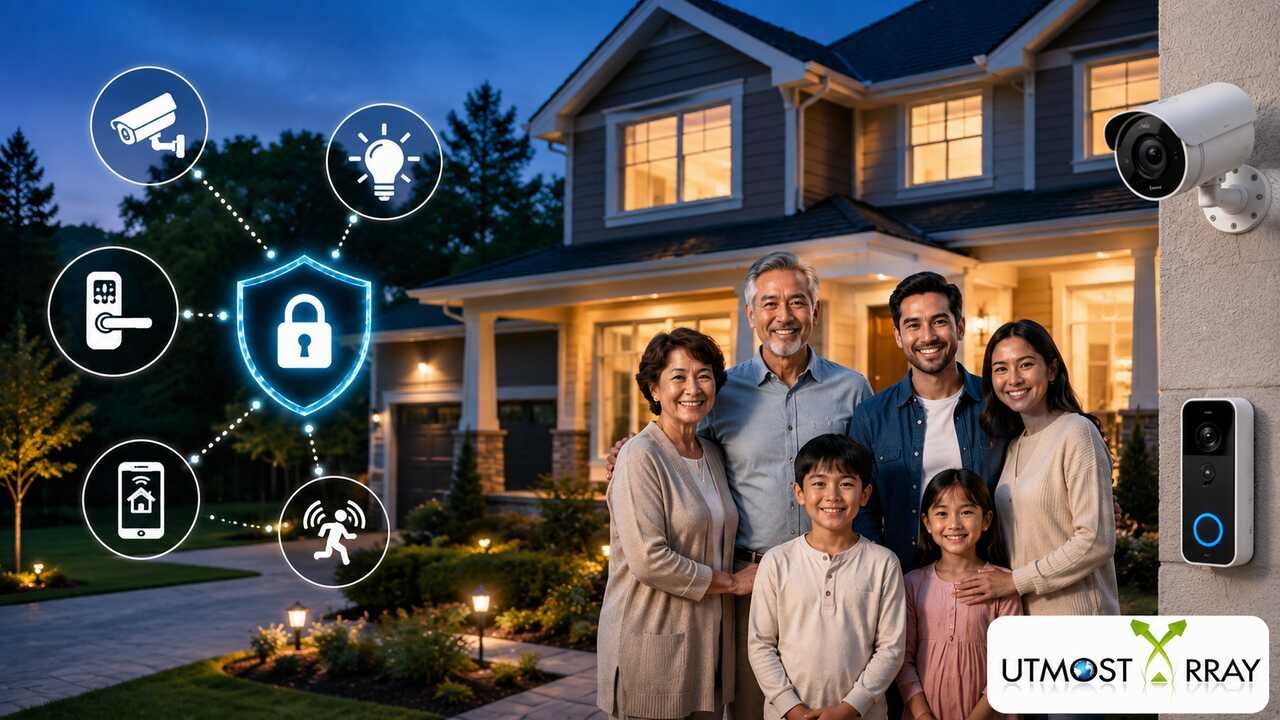
Multi-generational homes are designed to look like any single-family residence from the street, but behind the front door, they operate more like a small apartment building. This divergence creates unique security challenges and operational headaches for families in a positive trend.
Access control for different occupants, with different schedules, and likely different desires as it relates to privacy, is a real, recurring security problem and one that most households try to solve with a drawer full of duplicate keys and good intentions.
Why Shared Living Creates Security Friction
The routine activities of a multi-generational house conspire against regular security. A teenage grandson returning after midnight may leave the front door untended, not wanting to disturb his grandmother. An elderly relative who habitually wakes at 5am to meditate in the garden room may not want to fuss with locks while bleary and barefoot. A shift-working granny-flat renter has no overlapping schedule with the family next door. Everybody has a perfectly good reason for moving the way they do. Everybody’s routine creates a single point of failure.
Then there are the keys. One simple solution to keys multiplying like rabbits is to head down to the hardware store to make another seven for the new locks, then hand them out. Now everyone is walking around with more keys than they need and there’s now no room in your head for the combination lock for the pool equipment. Keys are lost or lent. Or not returned by the long-gone roommate. No one can account for who possesses keys.
This isn’t a character defect. This is what occurs when you take the security assumption of a residential unit being occupied by a fairly fungible nuclear family and try to stretch this very basic setup over a hugely varied set of living situations.
Mapping The Zones Before Touching A Single Lock
It’s important to identify the access zones within a household before making any decisions about hardware. There are three categories to consider:
Common zones, which everyone shares – the main entry, the front yard, the carport or garage, shared laundry facilities. Anyone with a legitimate connection to the household should have access here.
Semi-private zones, which are occupied by specific people who are entitled to privacy. An in-law suite, a converted garage apartment, a rented room with its own entry. The homeowner should have emergency access. The occupant should have daily access. No one else should have access.
Private zones, which are exclusive to the immediate family and not part of any lease agreement – the master bedroom, a home office with financial records, a secure storage room. Only the immediate family should have access to these.
Putting this down on paper, even in a rough sketch, reframes the issue. You stop considering the house as a single entity and instead view it as a system of different areas where various people legitimately require different levels of access. That’s the mindset that will guide you to the correct answer.
Why A Key Hierarchy Outperforms A Ring Of Individual Keys
Once you have zones mapped, you need a way to enforce them mechanically without creating an unmanageable key situation for the property owner. The standard professional answer to this is master key systems – they allow a single key to open multiple specific locks across a property while keeping other locks off-limits to lower-tier keys.
The mechanics work like this: a lock cylinder contains a series of spring-loaded pin stacks. In a standard lock, only one key profile raises all those pins to exactly the right height for the cylinder to turn. In a master-keyed lock, each cylinder is pinned with an extra set of driver pins – a “master wafer” – that creates a second shear line. This means two different keys can open the same lock: the user key, which only works on that specific lock, and the master key, which works on every lock in the system. The physical integrity of each lock is unchanged. An occupant’s key doesn’t work anywhere it’s not supposed to. The homeowner’s master key opens everything.
For a property with a main residence and an attached ADU, the hierarchy might look like this: the tenant gets a key that opens the ADU front door and the shared laundry room. The adult children living in the main house get a key that opens the main entry and the internal common areas. The homeowner holds the grand master key that opens every lock across the entire property. Nobody is carrying a bulky ring of seven keys, and nobody has access they haven’t been explicitly granted.
Tenancy, Emergency Access, And The Right To Quiet Enjoyment
Renting out part of the home – whether it’s a proper ADU or just a spare room – adds a legal wrinkle that family-only households don’t have to think about. Tenants have a right to quiet enjoyment of their space, meaning the landlord generally can’t just let themselves in without giving proper notice first, outside of genuine emergencies.
The master key system has to respect that boundary rather than quietly work around it. If the landlord holds an emergency-access key, it needs to stay secured and only be used within whatever notice period the law requires. Some landlords handle this by locking the grand master away in a combination lockbox that only they can open – partly for security, but also to make clear the key isn’t something they’re using day-to-day.
It’s also worth putting the key arrangement in writing. Nothing fancy – just a signed, dated note of who has which keys and when they were handed over. That way, if there’s ever a disagreement about who let themselves in or a key that’s gone missing, both sides have something to point to.
The Case For Mechanical Over Digital In Mixed-Age Households
Smart locks are often touted as the easy modern solution, and they do solve specific problems. But in a multi-age household, they fail in predictable and expected ways.
The fingerprint reader can’t read dry, thin skin well enough to unlock the door, and grandma gets locked out. The phone needs to be charged and in possession, and the phone has died. The nine-year-old’s buddy learned the elevator access code. You see where this is going.
This doesn’t make the abovementioned smart locks useless! A video doorbell on the main is a fantastic theft deterrent. Automated lighting makes it look like the house is occupied. But treating them as the primary access control system for a house with a 75-year-old and a teenager is setting up for failure.
The solutions for that are literally centuries old at this point and prior to the 100 or so Smart In A Noun Startups, they worked great. A properly designed and implemented mechanical system like we discussed here doesn’t have batteries, doesn’t need Wi-Fi, and doesn’t care if your youngest leaves the patio door unlocked. It adds on a couple of centuries of proven value and continuous improvement to the smart stuff, rather than trying to half-heartedly replace them.
Restricted Keyways And Controlling Duplication
Another expense most households don’t budget until there’s an emergency: key duplication. A standard key cut at a hardware store can be brought to any key booth and multiplied. When a tenant leaves, short of the honor system, there is no easy way to ensure they haven’t kept a key. The only surefire way to have peace of mind is to assume they have cut copies and rekey every lock.
This is a terrible waste and wholly avoidable. Patented key control adds a layer of reassurance because, unlike standard keys, blanks for these keyways are only available to the manufacturer and are never sold to independent locksmiths or key shops. This doesn’t make the key ‘unpickable’ in some glamorous spy-thriller sense; you can always put your lock into a vice and turn it very slowly while testing thousands of keys, but that’s incredibly time consuming and impractical as a clandestine entry method.
What this kind of keyway does achieve is making duplication inadvisable by requiring the locksmith to see the key card and ID of the registered key holder and check the signature before cutting a duplicate. The lodger can’t walk across the street to the hardware store and return twenty minutes later with a copy of your key because key duplication is cash on the barrel head, for everyone’s protection.
For a turnkey or Nanny flat style property, ongoing guest room, or ADU turnover (up to and including tiny house on wheels in a pocket community) this is the most cost-effective lock control system to save you that ongoing headache of rekeying your locks after every tenant.
Building The Full Security Picture
While hardware is the basics, it won’t do the job by itself. A written key management policy – even a simple one-page document covering who holds which keys, what to do if a key is lost, and what the return policy is – reduces the friction that creates security gaps. People behave more carefully when there’s a clear, agreed process, and it removes the ambiguity when something does go wrong.
Pair the mechanical system with perimeter motion lighting, a video doorbell at the main entry, and a basic family agreement about locking up at night. None of these is expensive or technically complex. Motion lighting on dark side paths costs almost nothing and changes the risk calculation for opportunistic intruders. The video doorbell gives you a visual record of who’s coming and going without requiring anyone to change their behavior.
The physical security audit – walking every entry point, testing every lock, checking door frames and hinges, not just locks – should happen before you invest in any new hardware. A Grade 1 deadbolt on a door with a weak frame is still a weak door. The full picture matters. Multi-generational homes are genuinely complex security environments. They deserve to be treated that way – not with a drawer full of unlabeled keys, but with the same structured thinking that any shared residential building would get.

1 Comment
Pingback: How to Strategically Zone Your Home for Maximum Security and Quick Emergency Access