

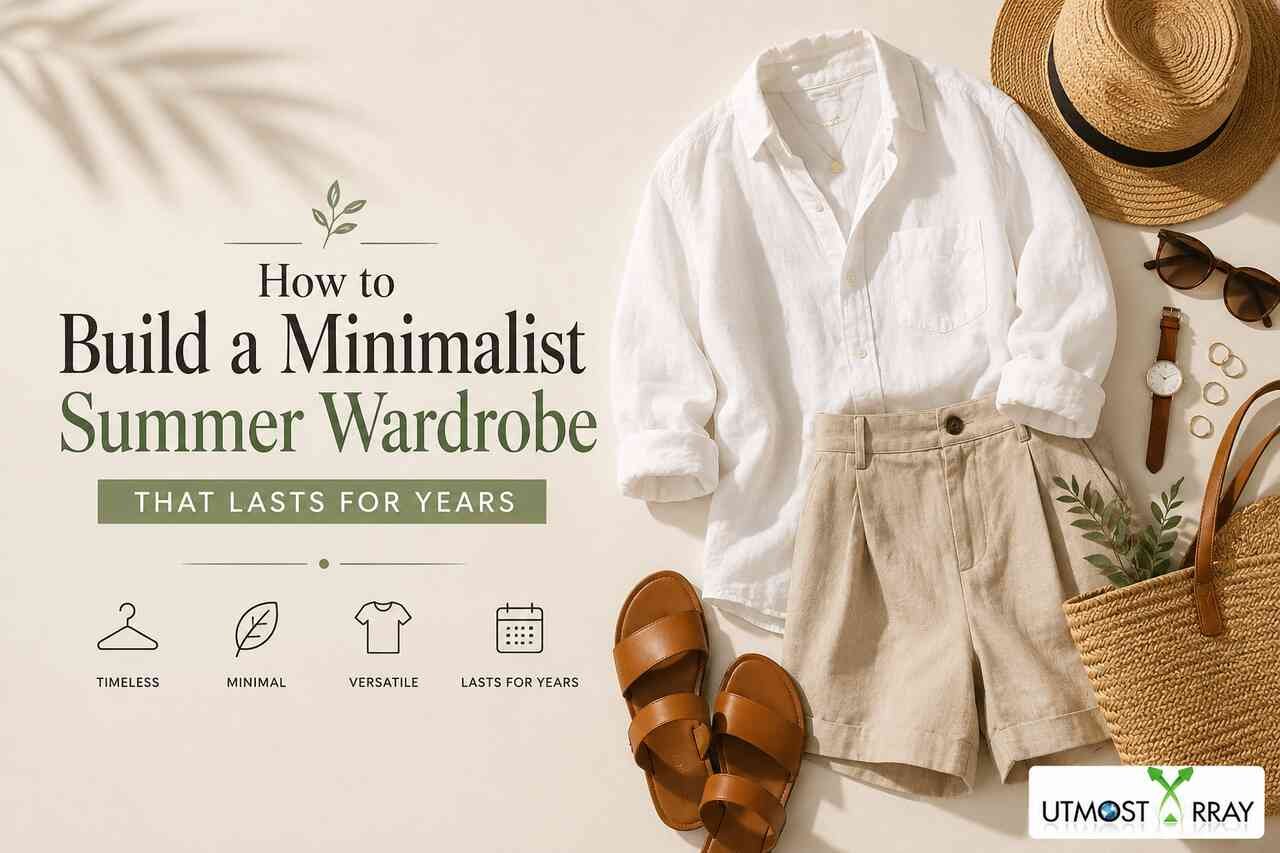
A pared-down summer collection is not about possessing fewer items just for the sake of it. It’s about possessing superior items – those that justify their presence because of the quality of materials, the integrity of their construction, and their capacity to function in various scenarios without disintegrating in a few months.
The difference becomes obvious the first time you reach for the same well-made shirt for the fourth time in a week and it still looks composed. That is the quiet utility a thoughtfully built wardrobe delivers, and it’s something a drawer full of cheaper alternatives never quite manages.
Start With Cost-Per-Wear, Not Sticker Price
Most people make summer clothing decisions backwards. They see a $15 linen-look shirt and buy three of them, then wonder why they’re repeating the exercise next July.
Cost-per-wear reframes the calculation. Take the purchase price and divide it by the number of times you’ll realistically wear it. A $90 shirt worn 60 times over three years costs $1.50 per wear. A $20 shirt worn eight times before it pills and loses its shape costs $2.50 per wear – and ends up in a landfill.
The average number of times a garment is worn before being discarded has decreased by 36% over the last two decades. That statistic reflects what fast fashion has normalized: disposable clothing cycles that cost more in aggregate and produce more waste. A minimalist summer wardrobe is the structural counter to that pattern, but it only works if the pieces you choose are actually worth wearing repeatedly.
When you evaluate any summer purchase, ask: will this still look like itself after 40 washes? If the honest answer is no, the price point is irrelevant.
Build Your Color Architecture First
Before you buy a single item, you need a color framework – and it should be tighter than you think.
A workable summer palette operates across three tiers. The first tier is your base neutrals: white, cream, bone, or sand. These form the majority of your wardrobe and interact with everything. The second tier is your supporting neutrals: one or two deeper tones like warm taupe, olive, slate, or black that ground the lighter pieces. The third tier is a single accent shade – something that appears in maybe two or three items and gives the palette a point of personality without fragmenting it.
That’s it. The discipline here is real, but so is the payoff. When every item sits within the same tonal range, there’s no such thing as a failed combination. Everything pairs with everything. A wardrobe of 20 pieces within a cohesive palette generates far more outfit options than 40 pieces in conflicting colors, and it takes up half the mental energy to dress each morning.
The mistake most people make is adding a “just one more” color item that seems neutral enough – a dusty rose, a muted sage – and suddenly the architecture starts to fracture. Hold the line on your accent shade. One is plenty.
Swimwear As ADual-Purpose Wardrobe Anchor
Minimal, functional summer wardrobes don’t separate swimwear into a special category. It’s a foundation block for styling across multiple uses. This is where the argument for quality in your swimwear is made. If you’re only going to own one or two pieces, they have to last and look good through a lot of wears.
Cheap swimwear fails fast and it fails in the same way, every time. Elastane and spandex provide the stretch that gives swimwear its shape. They’re the two fibers most vulnerable to chemical degradation from chlorine and saltwater. Incredibly cheap construction and fiber quality mean that degradation (and the subsequent shape loss and opacity) begins within a single season.
The rise of premium swimwear made with high-grade lycra and more sustainable materials, like Econyl, a regenerated nylon made from reclaimed ocean waste, goes a long way to establishing this baseline quality. The cut matters for longevity too – trend-driven silhouettes go stale fast and you’ll stop reaching for the piece even if the fabric is holding up. Timeless cuts with clean lines and classic proportions keep working year after year. High-quality, minimalist triangle bikini tops can easily double as supportive bralettes under sheer linen button-downs, offering a resort-ready look that transitions from the beach to an outdoor lunch. That kind of dual functionality is exactly what a capsule wardrobe demands from every piece it includes.
Double-lining in swimwear is a construction detail worth checking specifically. It ensures opacity when wet, prevents the fabric from losing its shape under the stress of water and movement, and adds structural integrity to the garment overall. Any swimwear described as “fully lined” should be evaluated to confirm that lining covers the full panel, not just a partial insert.
Fabric Selection For Summer Apparel: The Specifics Matter
Not every natural fiber is of the same quality, and the terms bandied about in the marketplace don’t mean what they used to. “Linen-blend” often becomes 45% linen, 55% of the cheapest grade of poly, and that shirt or pair of pants will pill, trap heat, and wrinkle in a way that won’t shake out of itself. Real linen, meaning the kind you’d want about 150-200 GSM, washes softer every time, breathes for real, and looks wonderful five years later if you hang it right.
Organic cotton creates much the same appeal. An organic, heavy weave will wear out three fast fashion versions of the thin one. Silk blends used in shirts for summer add a beautiful feel and the illusion of cool, though you’ll need to dry clean and avoid sunlight. What you’re most actively trying to avoid across all these categories is cheap poly: it doesn’t breathe, dies fast, and starts pilling within the month on every piece.
Beyond fiber-content, think construction. Double-stitching on lightweight summer wear indicates the company anticipates you laundering it and wants the seams to survive. Single-stitched seams on lightweight shoulder/hip summer wear will be the first to go. Check the hardware on anything that closes: metal buttons and solid zippers go years; plastic snaps and coated metal buckles usually do not.
When you’re in-store or thinking over your clicks online, hold the fabric up. If you can see your hand clearly through a shirt that isn’t supposed to be sheer, that GSM is telling you something. There is no tensile reserve in that fabric – if it stretches or thins in wear, it’s only going to get worse and more see-through.
Care Practices That Extend Garment Lifespan Significantly
The world’s best fabric degrades prematurely if you’re not careful. Summer clothes need special care and attention: swimwear, linen, and silk blends in particular.
Swimwear should be rinsed in cold fresh water immediately after chlorine or saltwater exposure. Not when you get back. Not after lunch. Immediately. The chlorine degradation process on elastane starts within minutes and the longer the exposure, the more structural damage accumulates. Rinse, reshape by hand, and dry flat in the shade. Never wring and never dry in direct sun, where UV exposure fades color and speeds fiber damage.
Linen and organic cotton summer fare best in cold machine washes on a gentle cycle or hand-washed for anything with embellishment or construction detail worth preserving. Skip the dryer for anything you want to last: air drying in shape, away from direct heat retains the fiber structure.
One perennially overlooked category: storage. Fine linen or silk blends folded on a sharp crease and left that way for months will find the fiber at the fold weakened. Store folded in a loose wad or hang if the weight of the garment won’t cause stretch.
Multi-Way Styling And The Footwear Rule
Each piece in a minimalist summer wardrobe must be able to cut it in at least two different contexts. A linen shirt that screams “beach cover-up,” therefore, doesn’t deserve a hanger. That same shirt, when tucked into wide-leg trousers, worn with clean sandals, should be just fine for a low-key dinner. A swimsuit that doubles up as a bodysuit beneath high-waisted shorts, does the job for both pool time and an afternoon in town.
Multi-way styling shouldn’t demand imaginative acrobatics: just stick to choosing items where the shape, and ideally, the shade leads you easily from one setting to another. This is why the fabric quality and the neutral palette decisions are not made in isolation: they feed into each other. A well-cut item in a quality neutral will see you through contexts a badly cut, cheap, trend-hue number never could.
Apply the same philosophy when acquiring summer shoes or slides. Slides multiply fast and aren’t shy about taking over your closet. Your one casual slide for sloping around the beach or pool, one leather (or leather-look) sandal for reading smart-casual, and one going-up option (wedge, mule, heeled slide) should see you through all summer and formal evening invites. All three should fall within your palette color range. Three shoes cover all eventualities.
Fit As AFinishing Investment
One aspect of building a wardrobe that is often overlooked is tailoring. Off-the-rack clothing for summer is designed to fit an average statistic. In other words, it fits most people okay and very few people well.
Make a small tailoring investment – hem wide-legged trousers, take in the waist of a linen dress, adjust the sleeve length of a summer blazer – and suddenly it’s not an occasionally worn item, it’s a constantly reached-for favorite. How you mentally record these pieces changes also. Clothing that fits well gets a little more respect, a little more care at laundering time, a little more love in storage.
For a wardrobe with few pieces, this matters more, not less. If you own eight summer pieces and three of them fit weirdly, you’ve got a functional wardrobe of five pieces. Tailoring is the investment that makes the other investments pay off.
A minimalist summer wardrobe doesn’t ask you to give up anything – it’s asking you to be intentional. Buy fewer items, but buy them with a solid understanding of fabric, construction, and how the piece operates within the whole. That method costs more today, and far less later.
