

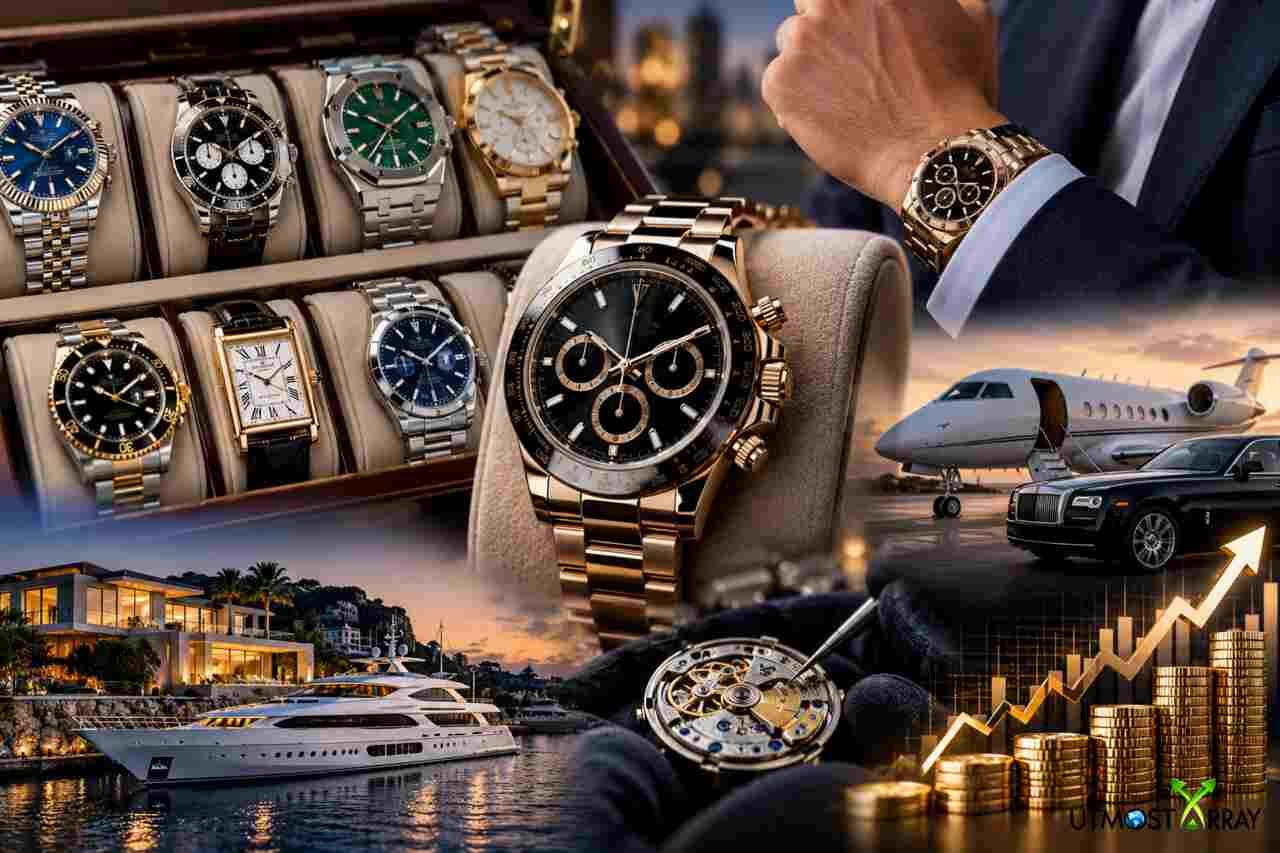
FintechZoom luxury watches combines the world of premium timepieces with insights into market trends, pricing, and investment potential. Renowned brands such as Rolex, Patek Philippe, Audemars Piguet, Omega, and Cartier attract collectors through their craftsmanship, iconic designs, and brand heritage.
What Are FintechZoom Luxury Watches?
The term FintechZoom luxury watches generally refers to luxury timepieces discussed or researched in connection with FintechZoom’s financial and lifestyle coverage. It does not identify a separate watch manufacturer, an official watch collection, or a recognized certification category.
The topic connects two areas: the luxury watch industry and the financial considerations involved in buying, collecting, and potentially reselling premium timepieces.
Luxury watches differ from ordinary fashion watches in several ways. Many feature mechanical movements, carefully finished cases, specialized complications, and manufacturing techniques developed over generations.
Well-known manufacturers such as Rolex, Patek Philippe, Audemars Piguet, Omega, and Cartier have established distinct positions in the market through design, engineering, craftsmanship, and brand identity.
For buyers, the central distinction is between a watch purchased for personal enjoyment and one purchased primarily with future resale value in mind. A timepiece can be exceptional in quality without appreciating in price.
Why Luxury Watches Attract Collectors and Investors
Luxury watches appeal to buyers for reasons that extend beyond their original function. Some people appreciate their mechanical complexity, while others value their historical significance, recognizable designs, or potential to retain value.
Craftsmanship and Mechanical Engineering
High-end mechanical watches contain intricate systems of gears, springs, and regulating components. Unlike quartz watches, mechanical watches rely on stored energy from a mainspring.
Automatic watches use a rotor that winds the mainspring through wrist movement. Manual-winding watches require the wearer to wind the movement periodically.
Manufacturers may also incorporate complications such as chronographs, annual calendars, perpetual calendars, moon-phase displays, and tourbillons.
These features increase mechanical complexity, although complexity alone does not guarantee higher resale value.
Brand Heritage and Recognition
Established watchmakers often have decades or centuries of history. Their reputations are supported by recognizable collections, technical achievements, and longstanding customer demand.
Rolex is closely associated with robust sports watches, while Patek Philippe is particularly recognized for traditional watchmaking and complicated mechanical timepieces.
Audemars Piguet helped popularize the luxury stainless-steel sports watch through the Royal Oak collection. Cartier, meanwhile, is celebrated for distinctive case shapes and designs that connect watchmaking with jewelry.
Collectibility and Scarcity
Certain watches become desirable because production is limited, particular references are discontinued, or collector demand exceeds the number available for sale.
However, scarcity should not be confused with guaranteed appreciation.
A watch can be rare without being widely desired. Conversely, a regularly produced model can command a strong secondary-market price when demand is exceptionally high.
Tangible Ownership
Unlike shares or digital financial assets, a luxury watch is a physical object that the owner can wear and enjoy.
That physical nature also introduces expenses and risks, including maintenance, theft, accidental damage, insurance, and storage.
The practical value of ownership therefore includes both the enjoyment of wearing the watch and the financial responsibilities that accompany it.
Top Luxury Watch Brands to Know
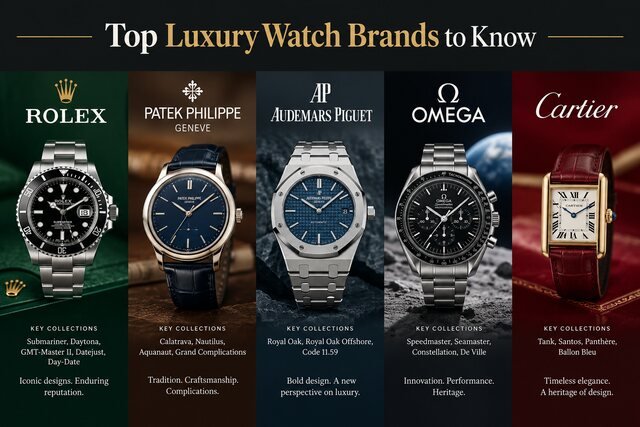
Several established watchmakers dominate conversations about premium timepieces. Each serves a somewhat different buyer, making it useful to compare them by design, reputation, and market positioning.
1. Rolex
Rolex is among the most recognizable luxury watchmakers, known for collections such as the Submariner, Daytona, GMT-Master II, Datejust, and Day-Date.
Its sports watches are particularly prominent in collector discussions, although resale performance varies substantially by reference and purchase price.
2. Patek Philippe
Patek Philippe is associated with traditional Swiss watchmaking, refined finishing, and complicated mechanical movements.
Collections such as the Calatrava, Nautilus, Aquanaut, and Grand Complications attract different types of collectors, from dress-watch enthusiasts to buyers seeking highly desirable sports models.
3. Audemars Piguet
Audemars Piguet is especially famous for the Royal Oak, introduced in 1972.
Its integrated bracelet and distinctive octagonal bezel helped redefine the luxury sports-watch category. The brand also produces the Royal Oak Offshore and Code 11.59 collections.
4. Omega
Omega is known for its Speedmaster, Seamaster, Constellation, and De Ville collections.
The Speedmaster Professional has a strong connection to space exploration, while the Seamaster line includes professional-style diving watches. Omega offers a broad range of mechanical watches across several price categories.
5. Cartier
Cartier combines watchmaking with a strong jewelry and design heritage.
The Tank, Santos, Panthère, and Ballon Bleu collections appeal to buyers who appreciate recognizable shapes and elegant styling. Both quartz and mechanical models are available across its collections.
Comparing Popular Luxury Watch Collections
The following table highlights differences among established collections rather than treating all luxury watches as interchangeable financial assets.
| Brand and collection | Distinguishing feature | Typical buyer interest |
| Rolex Submariner | Diving-watch design and strong recognition | Everyday luxury, collecting, resale liquidity |
| Patek Philippe Calatrava | Traditional dress-watch styling | Fine watchmaking and understated elegance |
| Audemars Piguet Royal Oak | Integrated bracelet and octagonal bezel | Iconic design and high-end collecting |
| Omega Speedmaster | Chronograph with spaceflight heritage | History, mechanical engineering, versatility |
| Cartier Tank | Rectangular case and classic design | Formal styling and design heritage |
| Jaeger-LeCoultre Reverso | Reversible rectangular case | Mechanical ingenuity and dress watches |
A buyer seeking an everyday sports watch may prefer a Submariner or Seamaster. Someone interested in formal styling may gravitate toward the Tank, Calatrava, or Reverso.
These differences matter because the best watch is not necessarily the most expensive or the most discussed online.
How Much Do Luxury Watches Cost?
Luxury watch prices range from several thousand dollars to hundreds of thousands or more for highly complicated, rare, or collectible pieces.
Price depends on the manufacturer, reference number, case material, movement, production status, condition, and distribution channel.
For budgeting purposes, buyers can divide the market into broad categories.
| Budget range (USD) | General market segment | What buyers may find |
| 2,000–5,000 | Entry-level and pre-owned luxury | Selected Swiss mechanical watches and pre-owned models |
| 5,000–10,000 | Established luxury | Many Omega, Tudor, Cartier, and selected Rolex references |
| 10,000–25,000 | Premium luxury | Higher-specification models and selected sought-after references |
| 25,000–75,000 | High-end collecting | Precious-metal watches and selected collectible sports models |
| Above $75,000 | Exceptional and collectible watches | Complicated movements, scarce references, and high-value pieces |
These are illustrative shopping budgets, not verified live retail prices or guaranteed ranges for particular models. Individual watches may fall outside the suggested categories.
Retail Price vs. Secondary-Market Price
Retail price is the amount charged by an authorized seller for a new watch. Secondary-market price is what buyers pay through dealers, marketplaces, auctions, or private transactions.
The two prices can differ significantly.
For example, a hypothetical watch with a $12,000 retail price might sell for $15,000 on the secondary market if demand is unusually strong and authorized supply is limited.
Another watch with the same retail price might sell pre-owned for $8,000 because demand is weaker or used inventory is plentiful.
This distinction explains why an expensive retail watch is not automatically a profitable purchase.
Additional Ownership Costs
The purchase price is only one part of the budget.
Mechanical watches may need servicing, especially when their performance or water resistance deteriorates. Owners may also pay for insurance, replacement straps, shipping, authentication, and secure storage.
Taxes and import duties depend on the buyer’s jurisdiction.
A realistic budget accounts for these expenses before the purchase rather than assuming the original price represents the total cost of ownership.
Are Luxury Watches a Good Investment in 2026?
Luxury watches can retain or appreciate in value, but their financial performance is highly dependent on the specific model, purchase price, market conditions, and resale costs.
The luxury watch market experienced unusually strong demand during the pandemic period, followed by price corrections across many sought-after references. By 2026, the market had become more selective, with buyers placing greater emphasis on established designs, condition, and realistic pricing.
Rolex remains prominent in the secondary market, while other manufacturers, including Cartier, Patek Philippe, and Vacheron Constantin, continue attracting collector interest.
However, a rising market index does not mean every watch has appreciated. Some individual models may increase substantially while others lose value.
Watches That May Hold Their Value Better
Collectors often focus on several characteristics when evaluating potential resale performance:
- Established demand: Models with a consistent history of buyer interest.
- Recognizable designs: Watches associated with longstanding collections.
- Original condition: Examples retaining their original components and finishes.
- Documented ownership: Watches accompanied by original paperwork and service records.
- Reasonable purchase price: Models bought near realistic resale-market values.
A highly desirable reference purchased at an inflated price can still produce a loss.
How to Evaluate a Luxury Watch Before Buying
A careful evaluation begins with the exact watch reference, not simply the brand name.
Two watches from the same manufacturer can have very different resale values because of their production years, dial variations, materials, and condition.
1. Identify the Exact Reference Number
The reference number identifies a particular model configuration or family.
For example, Rolex has produced numerous Submariner variations with different movements, case dimensions, materials, and design details.
Searching only for a Rolex Submariner may combine prices from watches that are not directly comparable.
Instead, buyers should compare examples with matching reference numbers and similar production periods.
2. Examine the Watch’s Condition
Condition strongly influences value, particularly in the pre-owned and vintage markets.
Check the case, bezel, crystal, dial, hands, bracelet, and movement.
Excessive polishing may reduce the appeal of certain collectible watches because it can alter the original case shape. Replacement components may also affect collector value, even when they improve functionality.
A professional inspection can help identify mechanical problems that are difficult to detect from photographs.
3. Verify Authenticity
Counterfeit watches have become increasingly sophisticated. Some may contain a mixture of genuine and non-genuine components.
A serial number, original-looking box, or warranty card should not be treated as conclusive proof of authenticity.
For high-value purchases, buyers should seek verification through the manufacturer, an authorized service center, or a qualified independent watch specialist.
4. Review Service History
Mechanical watches require appropriate maintenance.
A documented service history can help buyers assess whether a watch has been properly maintained and whether significant repairs may be needed.
However, vintage collectors may prefer certain original components to remain untouched. Servicing decisions should account for both mechanical reliability and historical originality.
5. Compare Actual Market Transactions
Advertised prices are not necessarily the amounts buyers are willing to pay.
A seller may list a watch for $18,000 even when comparable examples regularly sell for considerably less.
Where available, completed transactions and auction results provide stronger evidence of market value than asking prices alone.
Where to Buy Authentic Luxury Watches
Luxury watches are sold through authorized retailers, manufacturer-supported certified pre-owned programs, independent dealers, online marketplaces, and auction houses.
Each channel offers different advantages and risks.
Authorized Retailers
Authorized retailers sell watches through official brand distribution networks.
This is generally the most straightforward option for buyers who prioritize new condition, manufacturer warranties, and an established purchasing relationship.
However, popular models may have limited availability, and purchasing opportunities can vary between retailers.
Certified Pre-Owned Programs
Some manufacturers and retailers provide certified pre-owned watches that undergo inspection and authentication.
For example, Rolex’s Certified Pre-Owned program covers eligible watches that are at least two years old. Participating official retailers offer these watches with brand-backed authentication and a two-year international guarantee.
Certification may justify a higher price for buyers who value additional assurance.
Independent Watch Dealers
Reputable independent dealers can offer discontinued references, vintage pieces, and watches that are difficult to obtain through authorized channels.
Buyers should examine the dealer’s reputation, return policy, written authenticity commitments, and warranty terms.
A dealer’s reputation is particularly relevant when purchasing remotely.
Online Marketplaces
Online platforms provide access to international inventories and allow buyers to compare many examples of the same watch.
Before purchasing, review seller history, payment protection, inspection arrangements, import taxes, and return conditions.
Avoid transferring large amounts through unprotected payment methods to unfamiliar sellers.
Auction Houses
Auctions may offer rare or historically important watches.
However, buyers must account for buyer’s premiums, taxes, condition reports, and the possibility of competitive bidding pushing the final cost beyond the original budget.
An auction estimate is not a guaranteed purchase price or future resale value.
How to Spot a Fake Luxury Watch
Counterfeit luxury watches can resemble genuine models closely, especially in online photographs.
Authentication should involve multiple checks rather than relying on a single visual detail.
Examine the Dial and Finishing
Luxury manufacturers typically maintain precise production standards.
Misaligned printing, uneven hour markers, poor finishing, and inconsistent lettering can indicate a problem.
However, visual quality alone cannot prove authenticity because sophisticated counterfeits may reproduce these details convincingly.
Check the Movement
The movement is one of the most important areas for authentication.
A watch advertised as containing a particular mechanical caliber should have the correct movement architecture and components.
Movement inspection often requires specialized tools and professional knowledge.
Investigate Serial and Reference Numbers
Serial and reference markings should be consistent with the model and production period.
Yet counterfeiters can copy legitimate numbers, so matching markings are not sufficient evidence by themselves.
Be Cautious About Unusually Low Prices
A watch advertised far below prevailing market value deserves additional scrutiny.
The seller may be offering a counterfeit, a stolen item, a heavily modified watch, or a genuine piece with undisclosed mechanical problems.
A low price does not automatically mean fraud, but it should trigger more extensive verification.
Luxury Watch Market Trends in 2026
Several developments are influencing how collectors evaluate premium watches.
Greater Attention to Secondary-Market Pricing
Buyers increasingly have access to historical pricing information through watch-market platforms and transaction-based indexes.
These resources help collectors compare current valuations with earlier periods and identify differences between brands.
Still, an index reflects a selected group of watches rather than the performance of every model.
Interest in Classic and Versatile Designs
Traditional designs remain relevant alongside luxury sports watches.
Collections such as the Rolex Datejust, Cartier Tank, and Patek Philippe Calatrava offer styles that can be worn across formal and everyday settings.
Collector preferences may shift between larger sports watches and smaller, more restrained designs over time.
Increased Importance of Authentication
As online watch trading expands, authentication and documented condition become increasingly valuable.
Buyers are paying attention to original components, service records, seller guarantees, and independent inspections.
This is particularly relevant when purchasing expensive pre-owned watches across international borders.
Digital Marketplaces and Price Transparency
Digital platforms allow collectors to compare watches across countries and sellers.
Greater transparency can improve price discovery, but it also exposes buyers to inconsistent listing quality and different consumer protections.
Currency movements, taxes, shipping expenses, and regional demand can create significant differences between an attractive advertised price and the final purchase cost.
Luxury Watches vs. Traditional Investments
Luxury watches are sometimes discussed alongside stocks, gold, and other alternative assets. However, their financial characteristics differ considerably.
| Factor | Luxury watches | Stocks | Physical gold |
| Primary value driver | Collector demand and watch characteristics | Business performance and market expectations | Gold market supply and demand |
| Regular income | None | Possible dividends | None |
| Liquidity | Depends on model and buyer demand | Generally high for actively traded listed shares | Depends on form and dealer |
| Ongoing costs | Service, insurance, storage | Brokerage and possible account fees | Storage, insurance, dealer spreads |
| Valuation | Reference-specific and condition-dependent | Public market prices | Widely quoted market prices |
| Personal use | Can be worn and enjoyed | No physical use | Limited practical use as investment bullion |
The comparison highlights a central limitation: luxury watches are not standardized financial instruments.
Two examples of the same reference may command different prices because one has original paperwork, a better-preserved case, or a more desirable production configuration.
Traditional financial assets generally offer more standardized valuation and transaction processes.
A luxury watch may provide emotional and practical enjoyment that financial securities do not, but that benefit should not be mistaken for a measurable investment return.
How to Choose Your First Luxury Watch
First-time buyers should begin with intended use and financial comfort rather than choosing a model solely because it is popular.
A structured approach can reduce expensive mistakes.
Set a Realistic Budget
Determine how much you can comfortably spend without relying on future appreciation.
Include potential service costs, insurance, taxes, and accessories.
Avoid using money intended for essential expenses or emergency savings.
Choose the Right Watch Category
Different designs suit different lifestyles.
A diving-style watch may be appropriate for someone who prefers a robust everyday appearance. A dress watch may suit formal clothing and smaller wrist sizes.
Chronographs appeal to buyers who appreciate additional mechanical functionality, while simple three-hand watches may offer greater visual restraint.
Consider Case Size and Comfort
Case diameter alone does not determine how a watch fits.
Lug-to-lug length, case thickness, bracelet design, and overall weight can significantly affect comfort.
Whenever possible, try the watch on before purchasing.
Compare New and Pre-Owned Options
New watches may provide the convenience of a full manufacturer warranty and a straightforward ownership history.
Pre-owned watches can offer access to discontinued models or lower entry prices.
However, a lower purchase price may be offset by servicing or repair expenses.
Buy a Watch You Would Still Enjoy if Its Value Declined
This is one of the most useful tests for a first luxury watch purchase.
If a watch’s resale price fell by 20%, would you still appreciate its design, craftsmanship, and wearing experience?
If the answer is yes, the purchase may offer lasting personal value even if it does not generate a financial return.
Common Mistakes Luxury Watch Buyers Should Avoid
One frequent mistake is purchasing a watch based entirely on social media attention. Online popularity can increase demand temporarily, but it does not guarantee lasting collector interest.
Another is assuming that every limited-edition watch will appreciate. Production scarcity only matters financially when sufficient demand exists.
Buyers also sometimes overlook service expenses or fail to distinguish between a dealer’s asking price and a realistic resale offer.
Purchasing without authentication, ignoring return conditions, and failing to check import charges can create additional financial risk.
Finally, buyers should be cautious about treating luxury watches as highly liquid investments. Selling a watch at an acceptable price may take time, particularly when market conditions weaken.
Conclusion
FintechZoom luxury watches brings together an interest in prestigious timepieces and the financial realities of the luxury watch market. Brands such as Rolex, Patek Philippe, Audemars Piguet, Omega, and Cartier offer distinctive combinations of craftsmanship, heritage, design, and collector appeal.
The most important buying decision is not simply which brand is the most famous. It is whether a specific watch offers the quality, authenticity, condition, comfort, and price that justify its purchase.
For collectors interested in potential resale value, researching exact references, comparing completed sales, calculating ownership costs, and understanding market risks are more useful than relying on general claims about luxury watches appreciating.
A carefully selected luxury watch can provide years of enjoyment and may retain meaningful resale value. Any financial gain, however, should be treated as a possibility rather than a promise.
FAQs
Is FintechZoom a luxury watch brand?
No. FintechZoom is a financial and lifestyle media platform, not a luxury watch manufacturer. The phrase refers to interest in luxury watches within the context of financial information, premium products, and watch-market analysis.
Which luxury watch brand has the best resale value?
There is no single brand that guarantees the best resale performance. Certain Rolex, Patek Philippe, and Audemars Piguet references have historically attracted strong collector demand, but results depend on the exact model, condition, purchase price, and market timing.
Can luxury watches lose value?
Yes. Luxury watches can depreciate significantly, particularly when purchased at inflated secondary-market prices. Changes in collector preferences, economic conditions, production availability, and watch condition can all reduce resale value.
Are pre-owned luxury watches worth buying?
Pre-owned watches can offer good value when they are authentic, correctly priced, and in suitable mechanical condition. Buyers should verify service history, inspect the watch, understand warranty coverage, and compare comparable transactions before purchasing.
How often should a luxury watch be serviced?
Service intervals vary by manufacturer, movement, usage, and environmental conditions. Owners should follow the manufacturer’s recommendations and seek professional inspection when accuracy, power reserve, or other functions deteriorate. Water-resistance checks may be needed more frequently, particularly for watches regularly exposed to water.
Can a luxury watch be considered an alternative investment?
A collectible watch can be treated as an alternative asset, but it carries substantial risks. Prices are model-specific, selling costs can be significant, and future demand is uncertain. Buyers should distinguish collectible ownership from conventional investment planning.
