

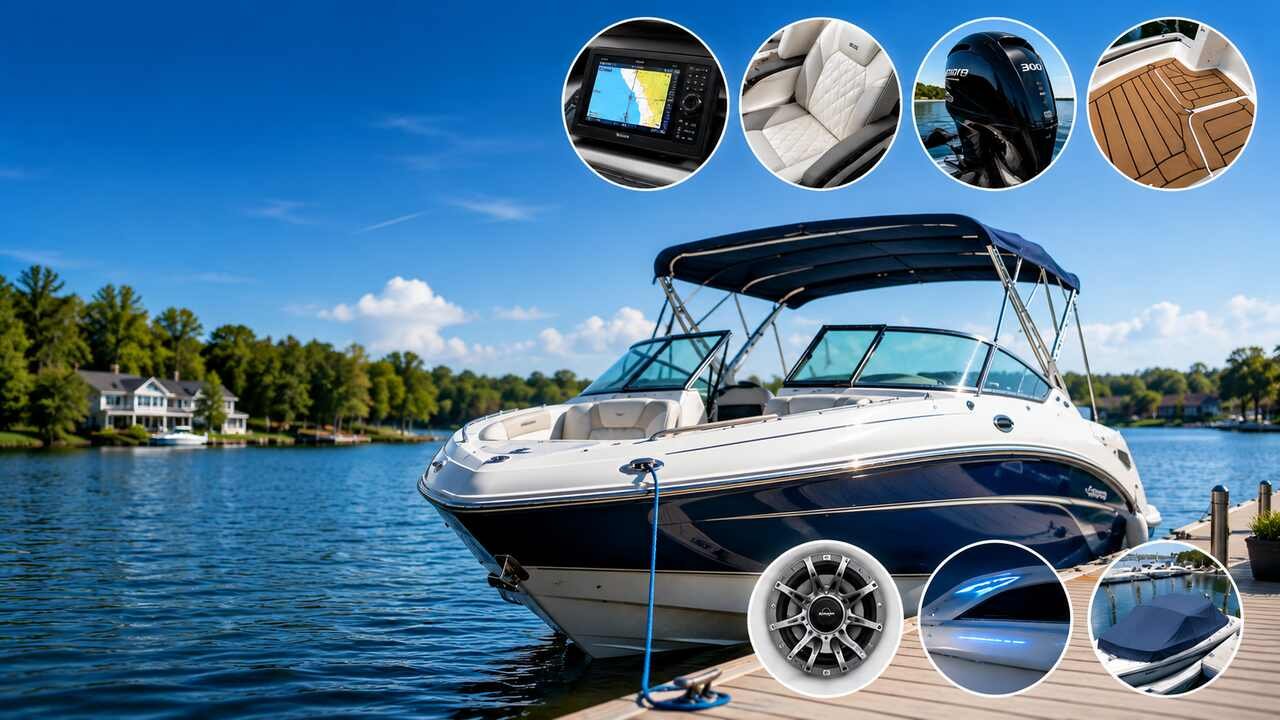
Buyers are well into the game before the broker unfolds the spec sheet. They’ve read the online listing and seen the photos. Perhaps they’ve even taken a virtual tour. Buyers know within minutes whether this is a boat for them or not. So before they’ve even seen the engine room or realized how spacious the forward cabin really is, you need to catch them. That means prepping the boat with a plan.
Hull appearance sets the negotiation floor
When you look at a used boat with fresh eyes, what do you see? Maybe the familiarity of a layout you know you love or the styling that caught your eye online? Or do you look past all that directly at the stuff that’s most expensive to fix?
If you’re a serious buyer, you do the latter. Not because you won’t have to pay for both, but because a good first impression is just as valuable as what you can ride out of the yard without having to immediately fix.
For buyers, novice and experienced alike, the smell is your first big hint. A boat that smells of mildew, stale fuel, or sewage at the dock isn’t likely to smell lovely at the marina or on the hook either. It’s unfortunate because smells are seared into your memory more effectively than good memories.
Your second clue is the gelcoat. Ask most brokering professionals and they will tell you the evidence of a boat being little-loved – or worse, left to rot in the sun and salt – is in the state of the gelcoat.
Seating: the upgrade with the highest return on investment
This is the part most sellers fail to account for in the psychology of the buyer. Cockpit seating is what a person actually feels. Sits in. Shifts their weight in, rubs their fingers over the surface, looks at the stitching. If the vinyl is cracked, faded to grey, or has absorbed decades of sunscreen to the point it feels sticky to the touch, the boat feels old.
Modern marine-grade vinyl – ideally 30oz weight or above – resists UV degradation, mildew, and salt cracking in a way that standard materials just don’t. When a buyer sits in clean, properly padded seats with intact stitching and marvels that this surface is 20 years old, the boat feels loved. That feeling is worth real money.
The seating replacement is also one of the few upgrades that comes close to a full return on investment. Well-maintained boats with updated interior upholstery and modernized marine electronics retain up to 20-30% more of their resale value compared to identical models with degraded cabins and weathered seating (National Marine Lenders Association). That’s not a marginal gain – that’s the difference between a quick sale at asking price and a weeks-long negotiation that ends below where you needed to be.
When looking for replacements, seek out specialized suppliers stocking a concentrated selection of marine-specific models. Owners improving cockpit layouts can search boat seats for sale to source seats designed for particular hull types and cockpit dimensions, rather than attempting to make ill-fitting generic outdoor furniture do the job.
One often underestimated factor in this process: the foam matters just as much as the vinyl on top. Closed-cell marine upholstery foam won’t absorb water, while open-cell foam will, with mold to follow. Simply switching out old, waterlogged foam for proper closed-cell foam ensures that the seat will maintain its shape, stay dry, and not smell, with odor particles that no amount of cleaning will get rid of.
Helm seating and what happens during the sea trial
The sea trial is the final test for a buyer. It is when they really make up their minds. And they are sitting in that helm chair most of the time. That means every turn of the prop, every hull slap, every minute through a slow zone – they’re experiencing it through the seat of their pants.
A wobbly, undersupported helm chair that hammers the driver’s back with each wave is a negative. A high-tech, mechanically-isolated ergonomic helm seat with flip-up bolsters and height adjustment is a game changer for the entire driving experience. It also sends a message to the buyer: this is a boat meant to be run, not one that’s been sitting at the dock.
For buyers who plan to actually use the boat – tournament fishing, weekend cruising, regular distance traveling – the captain’s chair isn’t a luxury. It’s a vital tool. A really excellent helm seat is one of the few pieces of gear that will upgrade both your show appearance and your ride.
Flooring: out with carpet, in with EVA foam
One of the worst things that can be found on a used boat is old marine carpet. It absorbs and holds on to water and smells, the edges fray, and over time, no matter how often you clean it, it always looks dirty. It’s also a sure sign to a potential buyer that if the carpet is wet and moldy below, so is the subfloor.
Goodbye, structural integrity, hello tough conversation.
EVA foam decking panels are now what you’ll find as the carpet alternative on almost any type of boat. They are closed-cell, so they don’t absorb moisture, they don’t get slippery when wet, and they are non-abrasive. They are easy to trim and shape to any hull, they come clean with a splash of water, and they give a boat a contemporary feel that makes a reasonable prospective buyer think, “This boat is set up right.”
Installation costs are competitive, the product is readily available in either single or two-tone color options that are subtle and don’t scream “aftermarket,” and the difference a couple of rolls can make in under an hour is massive. This is one of those improvements where all of the boxes get ticked when the decision is up close and personal or in a classified ad.
Modernizing the helm electronics
Having a helm filled with analog gauges that have all turned a nice shade of sun-faded yellow, and a GPS unit with a screen the size of a playing card – nothing will hasten a boat’s age on the used market faster than outdated electronics. Particularly when buyers are considering multiple boats and easily see that the gear looks like it’s from a different century.
Whether it’s technically new or not, ripping out all the old instruments and wiring and swapping in a modern, flush mounted multi-function display (MFD) that can handle all your navigation, depth, speed, and engine data on one sleek touchscreen, goes a long way to making a new boat out of an old hull. It goes a long way to making yourself feel more at home out on the troll too.
Just having modern electronics – even if you don’t also market them as BRAND NEW still works because nobody knows exactly how old your marine computer gear is, they just know what it looks like. A relatively new MFD actually can tell a buyer quite a bit about how the boat has been used and maintained. A well-integrated setup, with all the cables hidden and a MFD located front and center in the console will make things look neat and give the impression that you’re looking at an expensive boat the owner paid a lot of money for. A cluster of old mismatched bottom machine, plotter, and radar units all with wires running to them everywhere is more likely to draw questions about what else in the boat was sort of patched together.
Canvas, biminis, and what they signal about the interior
A worn out, loose, or ripped bimini top can be seen from thirty meters away. Canvas in that state lets a prospective buyer know that the interior has been cooking in direct sun for a few seasons, that UV rays have likely permeated every fabric on the boat, and that the previous owner was the sort to let something break before fixing it.
New canvas – be it a simple bimini, full enclosure, or T-top shade extension – is one of those things a buyer won’t specifically report as a reason they loved the boat, but they surely missed it if it wasn’t there. Fresh Sunbrella canvas or marine fabric equivalent indicates the cockpit and the cabin underneath have been protected. It’s not just looks, it’s evidence of care.
The same goes for any canvas enclosure aboard the boat. Side curtains, dodgers, spray shields – if they were OE from fifteen years ago and it shows, they need to be replaced before the listing goes live.
LED lighting and the after-dark impression
There are more potential buyers than you realize looking at boats in the late afternoon or evening, particularly at boat shows and dockside at busy marinas. LED cabin lighting and underwater transom lights are low-cost installations that have a disproportionately positive impact on how a boat presents itself after dark.
Warm-white LED panels in place of the tired old halogen cabin fixtures not only make the interior feel brighter and more modern, but also cleaner. Another ten dollars in the form of a blue or white LED underwater light at the transom of a boat that otherwise looks unremarkable in the slings at a boatyard turns that hull into a gleaming fisheye magnet after dark.
These aren’t baubles for 50-footers any longer. They’re pretty much standard gear on anything much above entry level these days. The argument about power efficiency with LEDs matters here, too. They draw a fraction the amperage halogens do, and a potential buyer who knows his way around a marine electric system knows that a boat with fewer loads on the battery and the alternator is going to require less maintenance.
The engine bay as a trust signal
Knowledgeable buyers – including the surveyors they hire – first visit the engine room. What they observe either confirms your estimated value or prompts them to start whittling down the price.
A bilge covered in grease, surfaces stained with rust, wiring connections corroded, and an oily residue may not mean mechanical breakdown, but it indicates an attitude toward ownership. People can’t peer into your cylinders or read your maintenance log just by looking. They will make some assumptions. Those assumptions will cost you thousands of dollars.
A pristine, professionally detailed engine room, including a washed block, recently repainted heat-transfer surfaces, no corroded connections, and labeled and clean wiring harness, costs money. It might be the difference between a buyer who feels you are asking a fair price and a buyer who’s hired a surveyor who will look for reasons to whittle it down.
A sparkling engine room doesn’t prove the engine is maintained. But it suggests you have treated the rest of your boat with the same kind of care and the buyer will pay for that assumption, to the tune of several thousand dollars.
Where to spend and where not to
Not all upgrades are created equal. A leaking windscreen or failed bilge pump must be seen as repair items and not investments into the resale value, as a buyer will simply lower their offer if either is not in proper working order regardless of what they would have offered otherwise. The items that do make a difference are the ones potential buyers can see, touch and feel on a walk-through and sea trial. Gelcoat, seating, decking, helm electronics, canvas, lighting, and engine presentation. These must be ready for photos, and the boat has to be the easiest number for you to come to terms with.
