

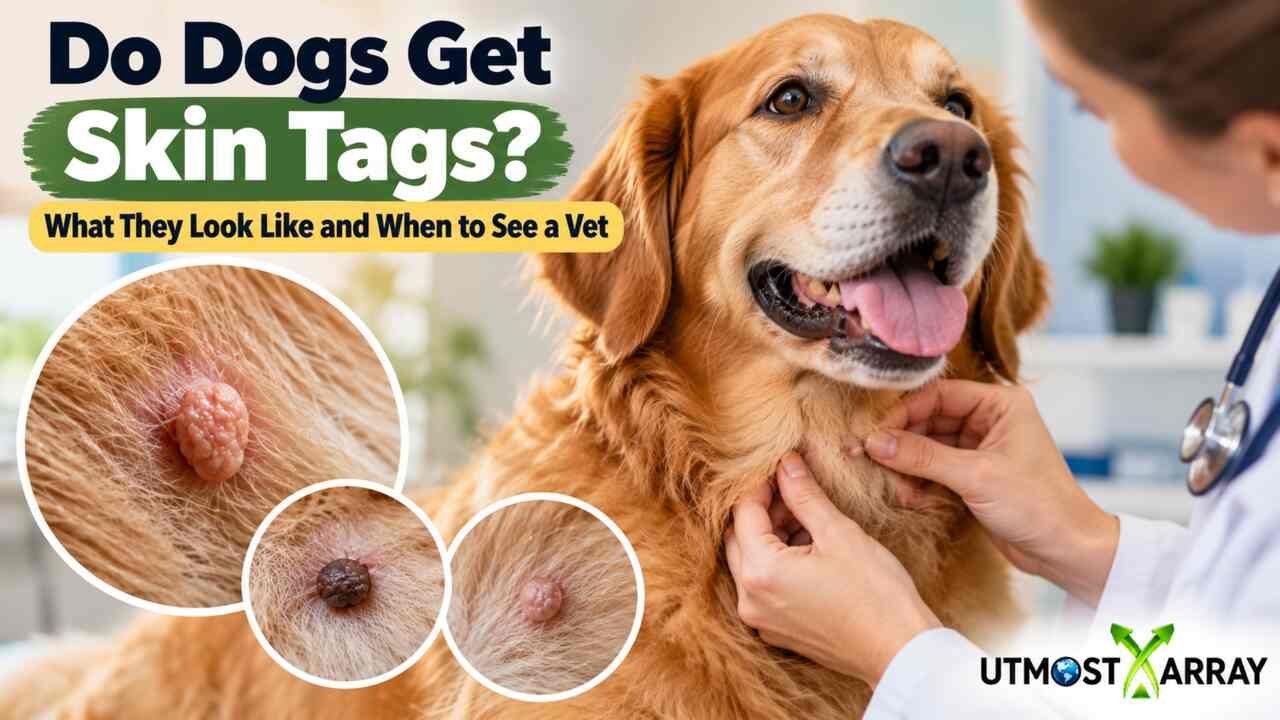
Yes, dogs can get skin tags, which are usually small, benign growths that are more common in older dogs. They often appear as soft or stalk-like pieces of skin and may also be called cutaneous tags, acrochordons, soft fibromas, or fibroepithelial polyps.
What Does a Skin Tag Look Like on a Dog?
A dog skin tag typically appears as a small growth projecting outward from the skin. Some have a narrow stalk connecting them to the body, while others look like raised, fleshy bumps. Their surface may be smooth or somewhat wart-like.
The color often resembles the surrounding skin, although pigmentation can vary between dogs and individual growths. Skin tags may be soft and flexible, but not every soft lump is a skin tag.
Dogs can develop one tag or several. Merck Veterinary Manual notes that dogs that develop one cutaneous tag may be prone to developing additional ones over time.
| Feature | Typical skin tag characteristic |
| Shape | Raised or hanging, sometimes attached by a stalk |
| Texture | Often soft or fleshy |
| Surface | Smooth or wart-like |
| Number | May occur alone or as multiple growths |
| Behavior | Usually slow-growing and nonpainful |
| More common in | Older dogs |
These characteristics are useful for recognizing something that might be a skin tag, but they cannot establish a diagnosis.
Where Do Dogs Get Skin Tags?
Skin tags can develop on different parts of a dog’s body. Because hanging or raised growths are easy to irritate, their location often determines whether they cause problems.
A tag in an area repeatedly rubbed by a collar, harness, leg movement, grooming equipment, or skin folds may become inflamed even if the growth itself is benign. Dogs may also lick, bite, or scratch an irritating growth, causing additional trauma.
Owners commonly notice small growths while grooming or petting their dogs. Areas worth checking regularly include the:
- Neck and chest
- Legs
- Armpits
- Abdomen
- Back and sides
- Areas around skin folds
- Head and face
A growth near an eyelid, paw, mouth, or another sensitive location deserves particular attention because even a benign mass can interfere with normal movement or irritate surrounding tissue. VCA notes that certain skin masses near the eyelid, for example, can irritate the eye and contribute to corneal injury.
Why Do Dogs Get Skin Tags?
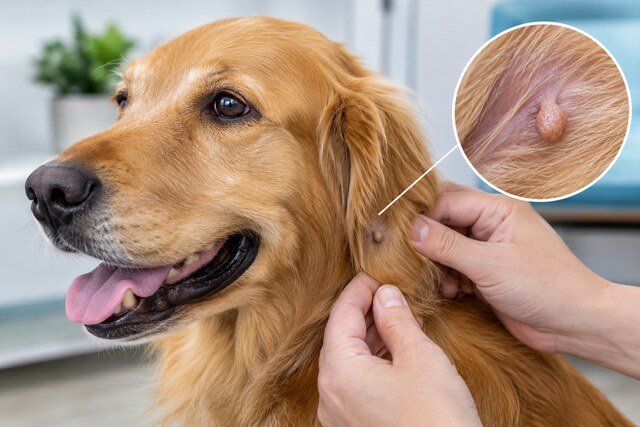
The exact reason an individual dog develops a skin tag is not always clear. Skin tags are benign fibrous skin growths involving cells and connective tissues within the skin.
They are strongly associated with age. Merck Veterinary Manual describes cutaneous tags as characteristic benign lesions of older dogs, although they can occur in any breed. Large breeds may have a higher risk.
Skin tags should not automatically be blamed on obesity, friction, allergies, or a particular food unless a veterinarian identifies another underlying skin problem. Several different conditions can produce similar-looking bumps, so determining the cause from appearance alone can be misleading.
Are Skin Tags on Dogs Dangerous?
True skin tags are benign, meaning they are not cancerous. In many cases, they remain small and cause no health problems. Treatment may be unnecessary if a veterinarian confirms the diagnosis and the growth does not bother the dog.
The main concern is that owners cannot always tell whether a growth is actually a skin tag. Many canine skin masses overlap in appearance.
Merck Veterinary Manual describes a documented mast cell tumor that initially appeared as a fleshy skin-tag-like growth. Mast cell tumors are an important canine skin cancer and can vary considerably in appearance.
That does not mean a skin-tag-looking bump is likely to be cancer. It means appearance alone should not be used to rule cancer out.
Skin Tag vs. Wart vs. Tumor: How Can You Tell?
Several canine skin conditions can resemble one another.
| Growth | Common appearance | Usually benign? | Veterinary evaluation useful? |
| Skin tag | Soft or stalk-like growth | Yes | Yes |
| Papilloma or wart | Raised, sometimes cauliflower-like | Often | Yes |
| Sebaceous or follicular growth | Raised, firm, sometimes hairless | Often, depending on type | Yes |
| Cyst | Rounded lump that may contain material | Often | Yes |
| Fibroma | Firm, rubbery or soft raised lump | Usually | Yes |
| Mast cell tumor | Highly variable, may resemble other lumps | Not necessarily | Yes |
Veterinarians often cannot identify every mass confidently from visual inspection alone. Depending on the growth, diagnosis may involve a fine-needle aspirate, biopsy, or surgical removal followed by laboratory examination. Cytology can identify certain types of cells, including mast cells, while biopsy allows tissue architecture to be examined in greater detail.
This is why descriptions such as “soft,” “fleshy,” or “looks like a skin tag” are useful observations but not definitive diagnoses.
When Should a Dog’s Skin Tag Be Checked by a Vet?
A newly discovered lump is worth showing to your veterinarian rather than assuming it is harmless. VCA recommends veterinary evaluation of new or changing masses because benign and malignant growths may look similar externally.
Arrange an examination sooner if the growth:
- Appears suddenly
- Grows quickly
- Changes noticeably in size
- Changes from soft to firm or vice versa
- Changes color
- Becomes red or swollen
- Bleeds
- Develops an open or ulcerated surface
- Produces discharge
- Seems painful
- Causes persistent licking or scratching
- Interferes with walking, eating, seeing, or normal movement
Rapid growth and sudden changes are particularly useful warning signs. VCA also advises closer investigation of suspicious lesions, chronically irritated areas, and skin abnormalities with unusual color or texture.
A previously examined growth should also be reassessed if its behavior changes.
How Veterinarians Diagnose Skin Tags
A veterinarian will usually begin by inspecting and feeling the growth. Its location, attachment to the skin, consistency, size, surface, and growth history all provide useful information.
The veterinarian may ask when you first noticed it and whether it has changed. Taking a photograph with a ruler beside the lump can help document changes between appointments.
If the diagnosis is uncertain, additional testing may include:
Fine-Needle Aspiration
A fine needle is placed into the mass to collect cells for examination under a microscope. This method can provide valuable information for many lumps and may identify certain tumors.
However, not every mass sheds enough cells for a definitive diagnosis. Merck notes that some connective-tissue growths may yield relatively few cells during aspiration.
Biopsy
A biopsy removes a small piece, or sometimes the entirety, of a lesion for examination by a pathologist.
Biopsy can help determine what type of tissue is present and whether malignant cells are involved. Merck specifically recommends biopsy to confirm the diagnosis of cutaneous tags.
Removal and Histopathology
In some situations, the veterinarian may recommend removing the entire growth, particularly if it is irritating the dog, repeatedly injured, growing, or suspicious.
The removed tissue can then be sent to a laboratory for histopathology, which provides a more definitive identification.
Do Dog Skin Tags Need to Be Removed?
Not necessarily. A confirmed skin tag that remains small and causes no discomfort may simply be monitored.
Merck Veterinary Manual states that treatment for canine cutaneous tags is optional. Removal techniques can include surgical excision, electrosurgery, or cryosurgery when appropriate.
Removal becomes more reasonable when a tag:
- Repeatedly catches on objects
- Rubs against a collar or harness
- Bleeds after grooming
- Becomes chronically irritated
- Causes discomfort
- Is positioned where the dog constantly licks or chews it
- Makes diagnosis uncertain
- Changes significantly
The decision depends partly on the dog’s age, overall health, the location of the mass, and whether anesthesia or sedation would be required.
Can You Remove a Dog’s Skin Tag at Home?
You should not cut, tie off, burn, freeze, or otherwise remove a suspected skin tag yourself.
First, the growth may not actually be a skin tag. Cutting an unidentified mass can cause bleeding, pain, infection, or damage to surrounding tissue and may delay diagnosis of a more significant condition.
Second, even apparently small tags may contain blood vessels. A veterinarian can determine whether removal is appropriate and control pain and bleeding safely.
Human skin-tag-removal products should also not be applied to a dog’s skin unless specifically directed by a veterinarian. Dogs may lick topical chemicals, and products formulated for humans are not automatically safe for animals.
What Should You Do If a Skin Tag Starts Bleeding?
Minor bleeding may occur if a protruding growth catches on something or gets scratched. Keep your dog from licking or chewing the area and contact your veterinary clinic for guidance.
Persistent bleeding, repeated trauma, marked swelling, discharge, or an open wound should be examined. A mass that repeatedly bleeds may need removal even if it proves benign.
Bleeding can also occur with growths other than skin tags, so a repeatedly damaged lump should not simply be treated as a cosmetic problem.
How to Monitor Lumps and Skin Tags at Home
Regular skin checks make it easier to notice meaningful changes.
Once or twice a month, run your hands over your dog’s body while grooming or petting them. If you discover a lump, record:
- Its location
- Approximate diameter
- Color
- Shape
- Texture
- Whether it moves under the skin
- Whether your dog reacts when it is touched
Take a clear photograph with a ruler or coin beside the growth for scale. Repeat the photo from roughly the same angle if you are monitoring it.
For example, a bump that measures approximately 5 mm for many months is behaving differently from one that increases from 5 mm to 15 mm within a short period. Growth rate does not establish whether a mass is benign or malignant, but it gives your veterinarian valuable diagnostic information.
Monitoring should complement veterinary assessment, not replace it.
Older Dogs and Skin Growths
Skin lumps become increasingly common as dogs age. Many are benign, and an older dog may eventually develop several unrelated masses.
Merck identifies skin tags and fibromas primarily as growths affecting older dogs. Fibromas, like skin tags, are generally benign, although removal may be recommended when they enlarge or change appearance.
An important practical point is to avoid assuming every new lump on an older dog is “just another skin tag.” Each new or changing mass deserves individual consideration.
One dog can have multiple benign lumps and still develop a completely different type of growth later.
Can Skin Tags Grow Back After Removal?
A completely removed skin tag generally does not simply regenerate in the same way as partially damaged tissue, although recurrence can depend on what the growth actually was and how it was removed.
More importantly, a dog that develops one skin tag may develop additional tags elsewhere. Merck notes that dogs with cutaneous tags can be predisposed to forming others over time.
Finding another tag after removal therefore does not necessarily mean the original procedure failed.
Frequently Asked Questions
Are skin tags common in dogs?
Yes. Skin tags are recognized benign skin growths in dogs and are especially associated with older animals. Any breed can develop them, although large breeds may have increased risk.
Can young dogs get skin tags?
They can develop skin growths, but classic cutaneous tags are more strongly associated with older dogs. A growth on a young dog may have several other possible causes, so veterinary evaluation is useful.
Are dog skin tags cancerous?
True skin tags are benign. The difficulty is that some tumors can resemble benign skin tags, so appearance alone cannot reliably determine whether a new mass is harmless.
Do skin tags hurt dogs?
Most uncomplicated skin tags should not be painful. They can become uncomfortable if they are rubbed, scratched, twisted, infected, or located where they interfere with movement.
Why is my dog’s skin tag getting bigger?
Some benign growths enlarge slowly, but a noticeable or rapid change in size should be checked by a veterinarian. Changes in size, texture, appearance, or behavior of a previously stable lump are reasons for reassessment.
Can I tie dental floss around my dog’s skin tag?
No. Do-it-yourself removal can cause pain, bleeding, infection, and injury, and the growth may not actually be a skin tag. Have the lump identified by a veterinarian before considering removal.
The Bottom Line
Dogs do get skin tags, particularly as they age. Genuine skin tags are benign and often need no treatment unless they become irritated, repeatedly injured, or troublesome.
The more important question is whether a particular lump really is a skin tag. Because benign growths and potentially serious tumors can sometimes look similar, have new or changing masses evaluated by a veterinarian rather than diagnosing them from appearance alone.
Once a veterinarian confirms that a growth is harmless, photographs and occasional measurements can help you monitor it for meaningful changes.
