

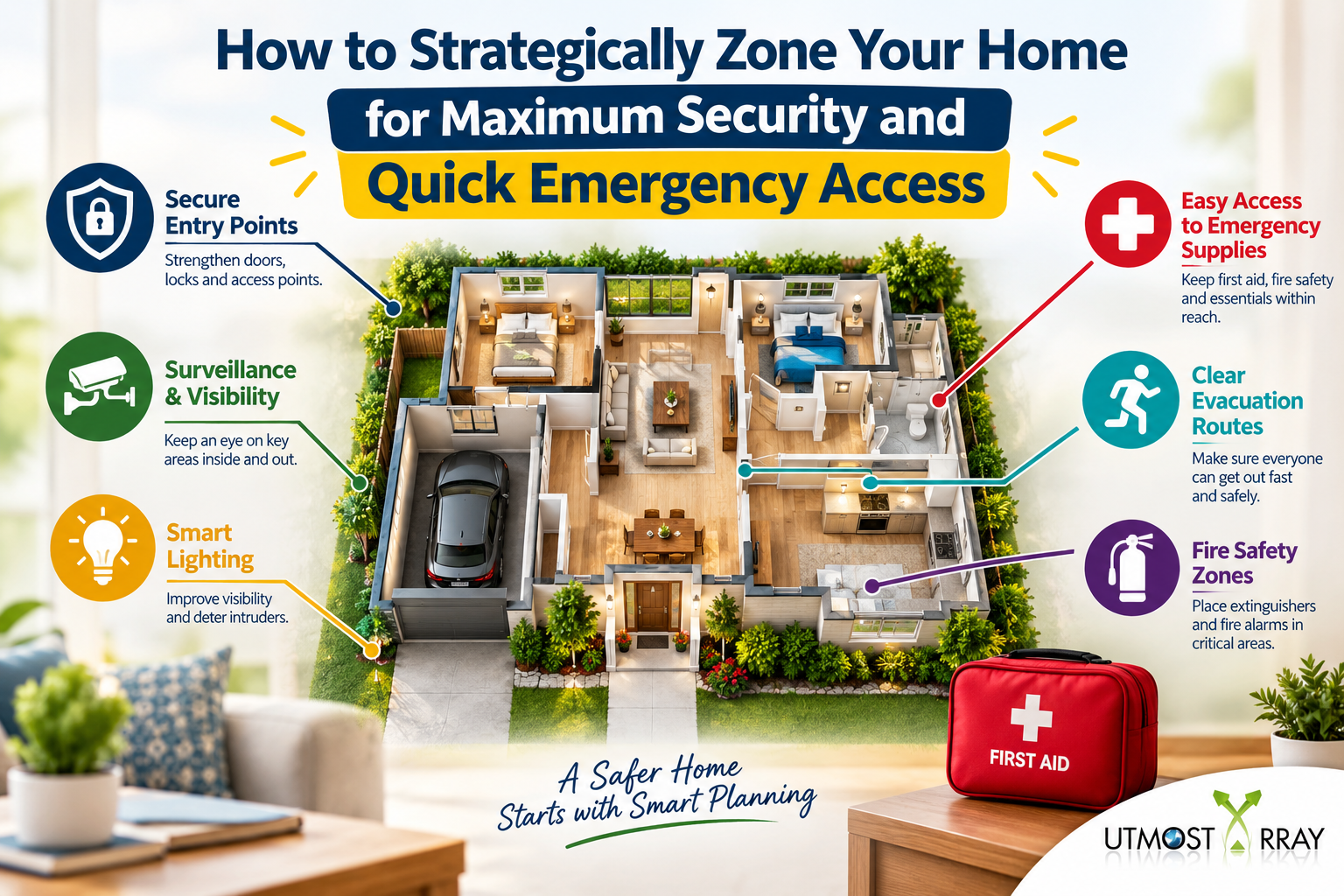
For many people, security is just about buying the right products, but the truth is that real security comes from how these products are used. Just like a house is more than just a pile of bricks, security is not just the sum of security products. It’s about the design and planning of how to use these products together to strengthen your defense against potential threats.
Security Is Architecture, Not Accessories
Security professionals sometimes refer to the “onion” model, which is based on a concept used in urban planning and building design. This model has also been applied in developing guidelines for crime prevention. The security “onion” model relies on the core philosophy: Security controls should be applied in layers. The underlying assumption is that no single security control is foolproof; in fact, no single control can even do everything.
If we generalize the model and consider it in a homeowners security context, the outer layer might be a fence or a wall installed around the premises to keep intruders at bay. It’s a physical and psychological deterrent. Middle layers might include cameras and lighting systems that help homeowners detect potential intruders, as well as make it harder for them to move throughout the property undetected. The final, inner layer, may include security systems coupled with a panic room.
Zone One: The Outer Perimeter
The outer zone includes everything from the street to your outside walls – fencing, landscaping, lighting, and sightlines. This zone doesn’t stop anybody. The point is to make your house look like more of a pain in the tail than the one next door. A couple of things here matter a whole lot more than people realize.
First, give the hedges-and-bushes crowd the bad news: Anything taller than the bottom of that window needs to be dropped down a foot or two. Overgrown shrubbery is a perfect hiding space for a crook, and it doesn’t take a criminal mastermind to just wait till dark to work and conveniently stay out of view of the street and the neighbors.
Second, motion-activated lighting is the best bang of all the high-value-low-cost options out there. Ten dollars, no monitoring, and you don’t even deal with a switch. Just trot on down to that big-box store for a lightbulb and install that motion-activated light with a sensor on every external door. They force anyone approaching after dark into a lit, exposed position they didn’t choose. They are the most glorious invention ever.
Zone Two: The Entry and Living Space
This is the point of entry that most burglars use because they don’t have to break in. They’re just walking in an unlocked door, popping a weak strike plate, or forcing a frame that was never reinforced. A typical deadbolt with a factory strike plate secured by half-inch screws is little more than a speed bump. Upgrading to a reinforced strike plate and using three-inch screws that drill into the structural stud of the door frame will turn a “single kick” breach into a several-minutes-long breach that’s also incredibly loud. Smart locks are a good complement to stronger deadbolts as they allow you to monitor and control access from a distance, which is important if you travel frequently or have children who tend to lose their keys.
Placement is also important here. Your primary living spaces should be designed with a direct line of sight to your primary entrances – front, back, and garage – as opposed to hiding them behind blind hallways or closed-off rooms. If you can see the door from your kitchen or living room, you’re more likely to notice someone trying to kick in your door. If you can’t, then your only defense is hoping that really expensive hardware works better than just being aware of your surroundings.
Why Hardening Actually Works
Naysayers might claim that if a burglar is determined enough, they’ll get in no matter what. Well, the truth is that they decide who’s an easier target based on certain info. In a survey of 422 convicted burglars conducted by the University of North Carolina at Charlotte, 83% of them said they would try to determine if an alarm was present before attempting a burglary, and 60% said if they discovered an alarm, they would seek another target.
This is precisely the function of zones one and two. You’re not attempting to build an insurmountable wall. You are signaling that you are trying, and most burglars will move on to easier pickings rather than put that to the test. Visible cameras, obvious lighting, and reinforced entries do a lot of heavy lifting before anyone actually even tugs on a doorknob.
Zone Three: The Secure Core
The innermost zone is the actual defense – where firearms, important documents, and irreplaceable valuables are kept. This should be a single, designated space located in an actual room or a corner of a room – think a reinforced closet, a small room, or a space that already has good sightlines and a lockable door.
The mistake a lot of people make is treating “secure storage” as scattered decisions – guns in a nightstand drawer, cash in a shoebox, jewelry in a dresser. That’s not a secure core; it’s a series of single points of failure. A dedicated gun cabinet or quick-access safe does what a drawer never could: it consolidates your most sensitive items into one hardened location, and it removes the temptation to keep a firearm “just accessible enough” somewhere unsecured, which is how many accidental firearm injuries involving children happen in the first place. If you’re deciding what belongs in that space, it’s worth taking a few minutes to know more about gun cabinet options built specifically for this kind of dual-purpose zone, since the right unit balances fast access for you against slow access for everyone else.
Solving The Speed-Versus-Safety Problem
The previous argument against safe gun storage used to be related to speed. It was believed that if your gun is locked away, it won’t be useful during a break-in. This argument no longer stands as a valid point. Modern quick-access safes can be biometric or mechanical keypad type that can be opened in one to three seconds by an authorized user. This is a reasonable speed in almost any home-defense situation. It is also slow and complicated enough to prevent a child, houseguest, or burglar from stealing your safe and running away with it. For biometric locks especially, your fingerprint will work immediately, but for anyone else, the safe will be useless. You don’t need to compromise between speed and safety anymore. Just select the hardware that best fits your core zone.
What A Real Intrusion Looks Like
How it works in real life: A perimeter camera catches motion near a side gate at 2 a.m. and pings your phone. That’s zone one, detection before contact. You rouse your family using a plan you talked through once, calmly, on a normal afternoon, not while fear was driving the bus. Everyone heads to the secure core.
Inside, you’ve got a locked door, a phone to dial 911, and a gun you can lay hands on if you have to. The zone isn’t a closet. It’s a rally point and, if it comes to it, a last-ditch barricade. None of that is working for you if “the secure core” is actually just the bedroom y’all were gonna hole up in anyway. It works because you made it that way on purpose.
Don’t Build A Fire Trap While You’re At It
Each burglary hardening decision has to be weighed against a second, more prevalent emergency: fire. Security bars, extra deadbolts, and cluttered “just in case” measures will all give you the same real problem – precious minutes must free you rather than trap you when seconds count and flames are spreading fast.
Egress routes must be kept 100% clear and operational including fast-opening window bars and a family rule that nothing is ever stored in hallways or in front of any exits. A good defense that keeps burglars on the street but traps your kids inside isn’t a good system. It’s a lawsuit waiting to happen.
Common Ways Homeowners Defeat Their Own System
A few habits can undo all of this planning. For instance, leaving exterior tools like ladders and pry bars in the yard gives intruders the exact tools they need to break in. Fences and gates meant for privacy can block the fastest escape route, and you won’t know until you need it. Guns left “out for quick access” in a nightstand undermine the entire point of a secure core, as does a “safe” that everybody in the house (plus every friend who’s ever come over) knows the location and combination of. It’s just a heavier drawer at that point.
None of these failures are particularly dramatic on their own. They are all just small compromises that feel reasonable at the time. But zoning only works if every layer holds, and the one compromise you make is going to be the one that gets tested.
Building a home this way takes a weekend of honest walk-throughs, not a shopping spree. Walk your property like someone trying to break into your house would, and then walk it again like someone trying to escape a fire would. If both routes make sense, you’ve got a system, not just a collection of locks and cameras that happen to share an address.
