

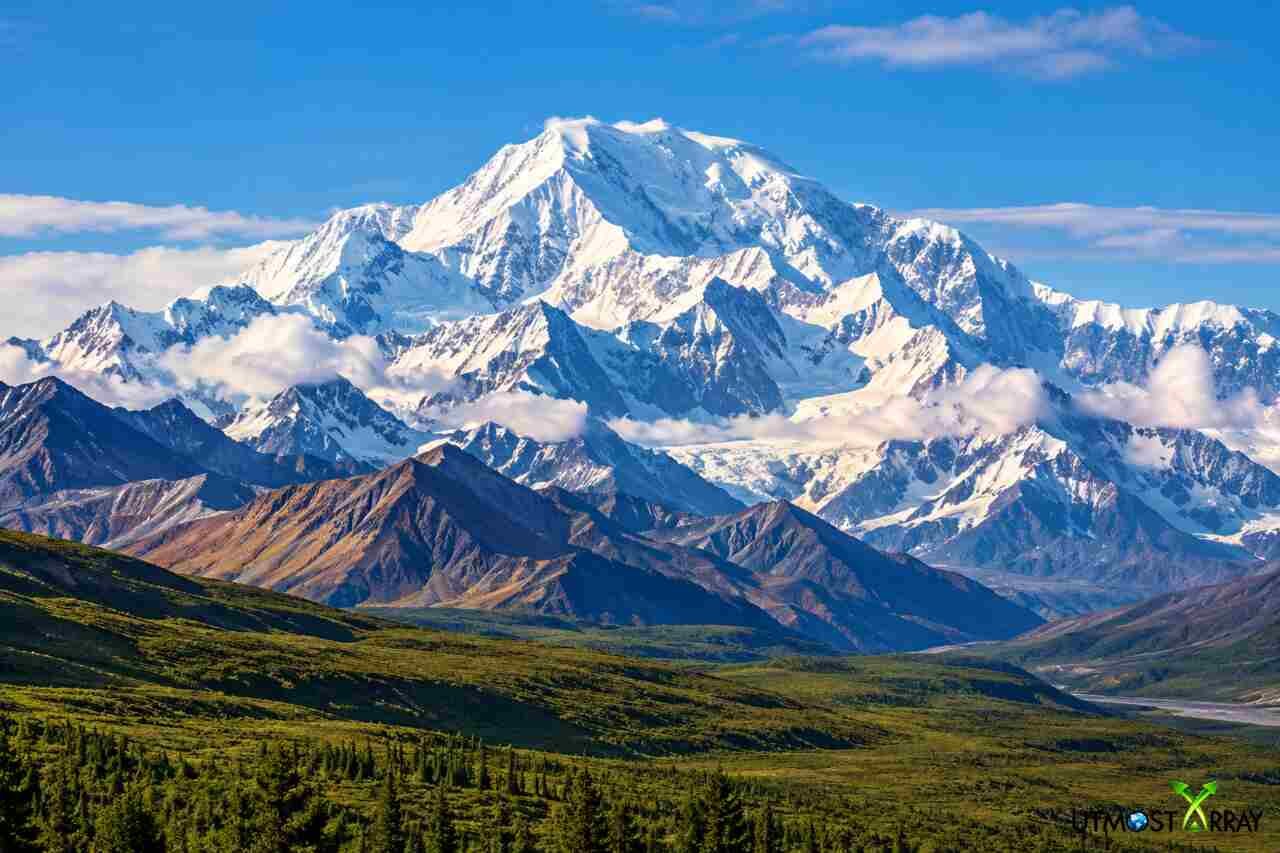
Denali, located in Alaska, is the tallest mountain in North America, standing at 20,310 feet (6,190 meters) above sea level. Situated in the Alaska Range within Denali National Park and Preserve, it is famous for its impressive height, massive glaciers, extreme weather, and challenging climbing conditions.
What Is the Tallest Mountain in North America?
Denali is the tallest mountain in North America, reaching an officially recognized elevation of 20,310 feet (6,190 meters). Located in Alaska, it is also the highest mountain in the United States and the third-highest of the Seven Summits, the highest peaks on each continent under the commonly used list.
What makes Denali particularly impressive is its enormous rise above the surrounding landscape. Unlike mountains that begin on already elevated plateaus, Denali rises dramatically from comparatively low terrain. This creates a striking visual presence and contributes to the challenging conditions encountered by climbers.
The mountain’s name comes from an Alaska Native tradition and is commonly translated as “the high one” or “the tall one.” Denali is an important cultural landmark for Alaska Native communities, especially the Koyukon Athabaskan people, whose relationship with the mountain extends back generations.
Where Is Denali Located in Alaska?
Denali is located in the Alaska Range, approximately 130 miles north-northwest of Anchorage. The mountain lies within Denali National Park and Preserve, a protected wilderness area covering more than six million acres.
Although Denali is geographically remote, visitors can access developed areas of the national park by road or rail. However, reaching the mountain itself requires specialized transportation and mountaineering preparation.
How Was Denali’s Height Measured?
Denali’s official elevation of 20,310 feet was established through a 2015 survey involving the U.S. Geological Survey and partner organizations. The project used advanced GPS measurements to determine the summit’s elevation more accurately.
Earlier measurements commonly listed Denali at 20,320 feet. The updated figure reflects improved surveying methods rather than evidence that the mountain physically lost ten feet of height.
Why Is Denali Considered One of the World’s Most Impressive Mountains?
Denali stands out because of its extraordinary vertical relief, northern latitude, and demanding environment. Although several mountains in Asia are significantly taller above sea level, Denali’s dramatic rise from its surroundings makes it especially imposing.
The mountain has two major summits, with the South Summit being the highest. Its massive slopes contain glaciers, snowfields, steep ridges, and exposed rock formations. These features create a landscape that attracts both scientific research and high-altitude expeditions.
Denali’s location also produces severe weather conditions. Its high latitude means climbers experience colder temperatures and lower atmospheric pressure than they might expect at comparable elevations closer to the equator.
How Does Denali Compare With Mount Everest?
Mount Everest is the world’s highest mountain above sea level, reaching approximately 29,032 feet (8,849 meters). Denali is considerably shorter by this measurement, but the two mountains present different geographical and climbing challenges.
Everest rises within the Himalayas, where much of the surrounding terrain is already extremely elevated. Denali, by comparison, rises from substantially lower surrounding terrain. Its northern location and harsh weather make it a formidable mountaineering objective despite its lower summit elevation.
What Makes Denali’s Vertical Rise Special?
Denali’s vertical rise is one of its most remarkable geographical characteristics. The mountain rises roughly 18,000 feet above some of its surrounding lowlands, although the exact figure depends on the reference point used.
This distinction matters because elevation above sea level does not always describe how dramatically a mountain dominates its landscape. When you view Denali from suitable locations, its massive elevation gain becomes one of its most visually striking features.
What Are the Highest Mountains in North America?
Denali ranks first among North America’s highest mountains, followed by Mount Logan in Canada and several other major peaks in Alaska and the Yukon. Most of the continent’s highest summits are concentrated in the Alaska Range and Saint Elias Mountains.
These regions contain some of the largest glaciers and most rugged mountain landscapes outside the polar ice sheets. Their elevations result from long-term tectonic activity involving the movement and collision of Earth’s crustal plates.
Understanding the rankings helps distinguish Denali from other famous mountains, including Mount Whitney and Mount Rainier, which are prominent U.S. landmarks but considerably lower.
Top 10 Highest Mountains in North America
The following table compares ten of North America’s highest major summits. Elevations are approximate and may differ slightly between surveys and mapping databases.
| Rank | Mountain | Location | Elevation (feet) |
| 1 | Denali | Alaska, USA | 20,310 |
| 2 | Mount Logan | Yukon, Canada | 19,551 |
| 3 | Pico de Orizaba | Mexico | 18,491 |
| 4 | Mount Saint Elias | Alaska/Yukon | 18,008 |
| 5 | Popocatépetl | Mexico | 17,802 |
| 6 | Mount Foraker | Alaska, USA | 17,400 |
| 7 | Mount Lucania | Yukon, Canada | 17,257 |
| 8 | Iztaccíhuatl | Mexico | 17,159 |
| 9 | King Peak | Yukon, Canada | 16,972 |
| 10 | Mount Bona | Alaska, USA | 16,550 |
This ranking uses commonly reported elevations and treats North America as including Mexico. Different lists may use different prominence requirements when determining which summits qualify as independent mountains.
Which Is the Tallest Mountain in the Contiguous United States?
Mount Whitney is the highest mountain in the contiguous United States, standing at approximately 14,505 feet (4,421 meters). It is located in California’s Sierra Nevada mountain range.
Although Mount Whitney is substantially lower than Denali, it remains a popular destination for experienced hikers. Its standard hiking routes are generally less technically demanding than Denali’s climbing routes, but altitude, weather, and physical preparation remain important considerations.
What Is the Geography and Climate of Denali Like?
Denali is characterized by enormous glaciers, steep mountain slopes, and some of the harshest high-altitude weather conditions in North America. Its location in the Alaska Range exposes it to powerful storms, freezing temperatures, and rapidly changing atmospheric conditions.
The mountain is part of a tectonically active region shaped by the interaction of the Pacific and North American plates. Over millions of years, geological forces have contributed to the uplift and development of the Alaska Range.
Denali’s surrounding wilderness also supports diverse ecosystems. Lower elevations contain forests, rivers, and tundra, while higher elevations transition into rocky alpine terrain, permanent snow, and glacial ice.
How Cold Does Denali Get?
Temperatures on Denali can fall far below zero, particularly at higher elevations. During severe winter conditions, temperatures near the summit can drop below minus 60 degrees Fahrenheit, while strong winds can make conditions even more dangerous.
Even during the main climbing season, typically May through early July, mountaineers must prepare for extreme cold, storms, and significant wind chill. Weather can change quickly, sometimes preventing climbing teams from moving for several days.
What Glaciers Surround Denali?
Denali is surrounded by several major glaciers, including the Kahiltna, Ruth, Muldrow, and Peters glaciers. These enormous ice formations shape the mountain’s landscape through erosion, movement, and the transportation of rock and sediment.
The Kahiltna Glacier is particularly important for mountaineering because it provides access to the popular West Buttress climbing route. Glaciers also serve as valuable indicators of environmental change, allowing scientists to study long-term changes in snow accumulation and ice movement.
How Difficult Is It to Climb Denali?
Climbing Denali is a serious high-altitude mountaineering undertaking that requires technical skills, physical endurance, and extensive preparation. It is not a conventional hiking destination, even though the popular West Buttress route is considered less technically difficult than some of the mountain’s other routes.
Expeditions commonly take approximately two to three weeks, depending on weather, acclimatization, and individual progress. Climbers often carry heavy backpacks while pulling sleds loaded with food, fuel, camping equipment, and climbing gear.
The mountain presents multiple hazards, including crevasses, avalanches, frostbite, altitude illness, and severe storms. Successful expeditions depend on careful decision-making, teamwork, and a willingness to turn around when conditions become unsafe.
What Is the Most Popular Route to Denali’s Summit?
The West Buttress is Denali’s most frequently climbed route. Most expeditions begin by flying to a glacier landing area on the Kahiltna Glacier, commonly accessed through Talkeetna.
Climbers then establish a series of camps while gradually gaining elevation. The route involves glacier travel, fixed lines on steeper terrain, and exposed high-altitude sections. Although it is the standard route, it still demands glacier rescue knowledge, rope skills, and experience traveling in extreme cold.
What Equipment and Preparation Do Climbers Need?
Climbers need specialized cold-weather clothing, insulated mountaineering boots, crampons, ice axes, ropes, tents, and reliable navigation equipment. Proper nutrition and equipment maintenance are also essential during extended expeditions.
Before attempting Denali, you should gain experience with glacier travel, crevasse rescue, winter camping, and high-altitude acclimatization. Working with a qualified guide service can provide additional support, but it does not eliminate the risks associated with the mountain.
How Can You Visit Denali National Park Without Climbing?
You do not need to climb Denali to appreciate its spectacular scenery. Denali National Park and Preserve offers wildlife viewing, hiking, photography, sightseeing, and opportunities to learn about Alaska’s natural environment.
The park is home to wildlife such as grizzly bears, moose, caribou, Dall sheep, and wolves. Visitors can explore accessible trails, join ranger-led programs, or travel along permitted sections of the park road.
However, one important consideration is visibility. Denali is frequently obscured by clouds, meaning visitors are not guaranteed a clear view of the summit. Planning multiple days in the region can improve your chances of seeing the mountain.
When Is the Best Time to Visit Denali?
June through August is generally the most convenient period for visiting Denali National Park. During these months, visitors benefit from long daylight hours, relatively mild lower-elevation temperatures, and seasonal tourism services.
Late August and early September can also be attractive because of autumn colors and potentially fewer visitors. However, weather becomes less predictable as the season progresses, and some services may operate on reduced schedules.
Where Can You Get the Best Views of Denali?
Several locations offer opportunities to see Denali without undertaking a mountaineering expedition. Popular viewing areas include Denali State Park, the Parks Highway, and selected viewpoints within Denali National Park.
Talkeetna is another popular destination for sightseeing flights, which can provide dramatic aerial views of the Alaska Range when weather permits. Before traveling, check current park road access and transportation availability, as landslides, maintenance, and seasonal conditions can affect visitor routes.
What Makes Denali Important to Alaska and North America?
Denali is important because of its geographical significance, cultural heritage, ecological value, and role in scientific research. As North America’s highest peak, it represents one of the continent’s most recognizable natural landmarks.
For Alaska Native communities, Denali carries cultural and historical meaning that extends beyond its elevation. Its traditional name reflects a longstanding relationship between Indigenous peoples and the surrounding landscape.
The mountain also contributes to Alaska’s tourism economy, attracting visitors interested in wilderness experiences, photography, wildlife, and mountaineering. At the same time, its protected environment provides opportunities to study glaciers, climate patterns, and high-altitude ecosystems.
Why Has Denali Also Been Called Mount McKinley?
Denali was officially known as Mount McKinley under federal naming conventions for much of the twentieth century, honoring former U.S. President William McKinley. Alaska officially adopted the name Denali in 1975, and the federal government restored Denali as the official name in 2015.
In January 2025, the federal government directed that the name Mount McKinley be restored. As a result, Mount McKinley is again the federal official name, while Denali remains widely used, particularly in Alaska, and continues to carry cultural significance.
Why Is Denali Important for Scientific Research?
Denali provides scientists with opportunities to study glacier behavior, mountain geology, atmospheric conditions, and environmental change. Its high elevation and extensive ice systems make it especially useful for understanding processes occurring in cold mountain environments.
Researchers also examine how changes in temperature and precipitation affect glaciers, wildlife habitats, and surrounding ecosystems. These observations contribute to broader scientific understanding of Alaska’s environment and the challenges facing high-latitude mountain regions.
Conclusion
Denali, also known federally as Mount McKinley, is the tallest mountain in North America, standing 20,310 feet above sea level in Alaska. Its remarkable vertical rise, massive glaciers, extreme climate, and cultural importance make it much more than a geographical record holder.
Whether you are comparing the continent’s highest peaks, researching mountaineering challenges, or planning an Alaskan vacation, Denali offers a fascinating combination of natural beauty and scientific significance.
If you want to experience the mountain without climbing, consider visiting Denali National Park during the summer and allowing several days for sightseeing. This gives you more opportunities to enjoy its wildlife, landscapes, and unforgettable mountain views.
FAQs:
1. What is the tallest mountain in North America?
Denali, also federally named Mount McKinley, is the tallest mountain in North America. It stands 20,310 feet (6,190 meters) above sea level and is located in Alaska’s Alaska Range. It is also the highest mountain in the United States and one of the Seven Summits.
2. Is Denali taller than Mount Everest?
No. Mount Everest is taller than Denali when measured above sea level. Everest reaches approximately 29,032 feet, while Denali stands at 20,310 feet. However, Denali has an exceptionally large vertical rise above its surrounding terrain, making it one of the world’s most visually imposing mountains.
3. What is the second-highest mountain in North America?
Mount Logan in Canada’s Yukon Territory is the second-highest mountain in North America. It reaches approximately 19,551 feet (5,959 meters) above sea level and is located within Kluane National Park and Reserve. Like Denali, Mount Logan is known for extensive glaciers, severe weather, and challenging climbing conditions.
4. Can beginners climb Denali?
Denali is not recommended for beginner mountaineers. Even its standard West Buttress route requires glacier travel skills, technical equipment, excellent physical conditioning, and experience managing extreme cold. Beginners interested in eventually climbing Denali should first develop mountaineering skills through professional training and progressively more challenging mountain expeditions.
5. How long does it take to climb Denali?
Most Denali expeditions require approximately 14 to 21 days, although the actual duration varies according to weather, acclimatization, route conditions, and team performance. Climbers must allow enough time for rest and weather delays. Reaching the summit is never guaranteed, and safe descent remains the expedition’s most important objective.
6. Can you see Denali without entering the national park?
Yes. Denali can be viewed from several locations outside Denali National Park, including sections of the Parks Highway, Denali State Park, and the Talkeetna area. Visibility depends heavily on cloud cover and weather conditions. On clear days, the mountain can be seen from considerable distances because of its exceptional height.
