


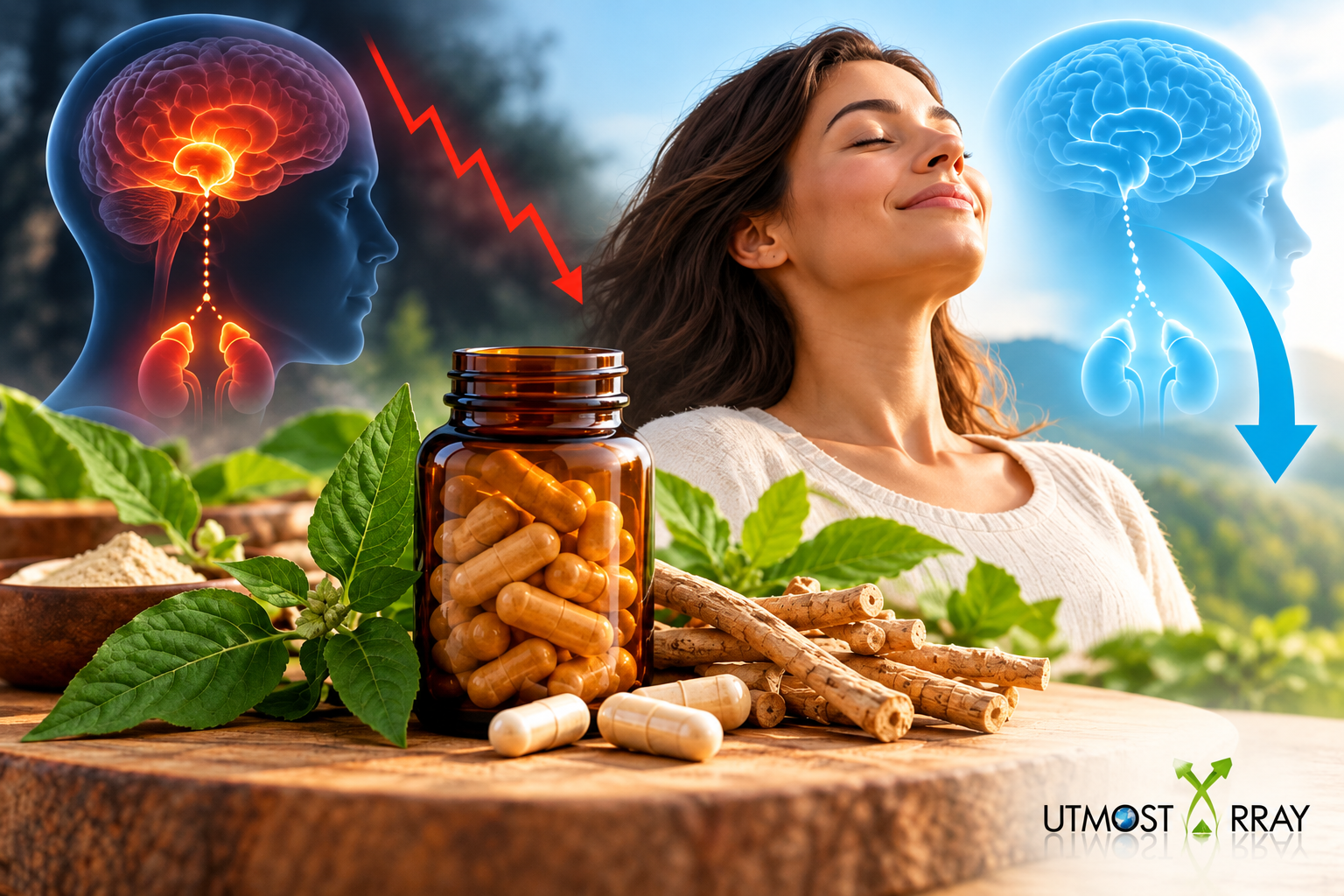
Ashwagandha appears to have some of the strongest human evidence among supplements for reducing stress-related cortisol. However, cortisol is a necessary hormone, and persistently high levels caused by a medical condition should be evaluated and treated by a healthcare professional rather than managed with supplements alone.
Which Supplement Has the Best Evidence for Lowering Cortisol?
For adults experiencing stress rather than a diagnosed cortisol disorder, ashwagandha (Withania somnifera) currently has the most consistent evidence specifically involving cortisol reduction.
The National Institutes of Health Office of Dietary Supplements reports that several clinical trials have found reductions in serum or salivary cortisol alongside improvements in perceived stress after ashwagandha supplementation. Trials have used different root, root-and-leaf, and standardized extracts, usually for several weeks.
A 2025 systematic review and meta-analysis covering randomized controlled trials found a statistically significant reduction in cortisol with ashwagandha compared with placebo. Another meta-analysis published in 2024 also found reductions in serum cortisol, although variability among formulations, doses, participant populations, and trial methods limits how confidently the findings can be generalized.
A more recent systematic review of randomized trials likewise found that ashwagandha affected cortisol, while emphasizing heterogeneity among the available studies.
This makes ashwagandha a reasonable evidence-based candidate, rather than a guaranteed cortisol-lowering treatment.
| Supplement | Evidence for cortisol reduction | What the research suggests | Major limitation |
| Ashwagandha | Moderate, relative to other supplements | Multiple trials and meta-analyses report lower cortisol in stressed adults | Small studies, different extracts and doses, limited long-term safety data |
| L-theanine | Limited and inconsistent | Some acute studies show a smaller cortisol response to stress | Longer-term trial results have not consistently shown lower cortisol |
| Phosphatidylserine | Limited | Some small studies suggest altered cortisol responses during psychological stress | Evidence is older and based on small populations |
| Magnesium | Weak for cortisol specifically | May support normal nervous-system function and help some people with stress or deficiency | Not established as a reliable cortisol-lowering supplement |
| Rhodiola rosea | Preliminary | Some trials have examined stress, fatigue, and cortisol-related outcomes | Trial quality and consistency remain limited |
| Omega-3 fatty acids | Limited for cortisol | May influence aspects of the physiological stress response | Cortisol reduction has not been demonstrated consistently |
How Much Can Ashwagandha Lower Cortisol?
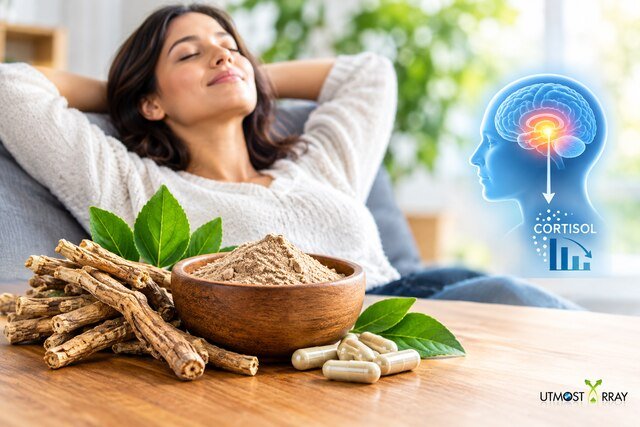
The available evidence suggests a measurable effect in some study populations, but there is no reliable percentage reduction that applies to everyone.
A 2025 meta-analysis of seven randomized trials involving 488 participants found that ashwagandha produced a statistically significant average reduction in cortisol compared with control treatment. The trials included adults experiencing stress and used oral doses of at least 250 mg per day for two weeks or longer.
A separate systematic review examining studies conducted through May 2023 found only nine eligible trials. The studies differed substantially in extract composition, dosage, treatment duration, cortisol measurement, and participants’ baseline stress levels. That variation is one reason a particular milligram dose cannot be assumed to produce a specific cortisol reduction.
The NIH review similarly notes that clinical studies have used approximately 240 to 1,250 mg per day of various extracts, with several studies reporting stronger effects around 500 to 600 mg per day. These figures describe research protocols, not a universal dose recommendation. Different extracts can contain substantially different concentrations of active compounds.
Ashwagandha Is Not Safe for Everyone
The evidence supporting ashwagandha does not mean it is appropriate for every person experiencing stress.
According to the National Center for Complementary and Integrative Health, short-term use for up to about three months appears reasonably well tolerated in many adults, but long-term safety has not been established. Possible adverse effects include stomach upset, diarrhea, vomiting, and drowsiness. Rare cases of liver injury have also been reported.
Ashwagandha should generally be avoided during pregnancy and breastfeeding. NCCIH also advises against its use for people with thyroid or autoimmune disorders and around surgery. Potential interactions include medications for diabetes, blood pressure, seizures, thyroid conditions, immune suppression, and sedative medications.
Anyone taking prescription medication or managing a chronic health condition should therefore discuss ashwagandha with a physician or pharmacist before using it.
Does L-Theanine Lower Cortisol?
L-theanine is promising for acute stress, but the evidence is less consistent than it is for ashwagandha.
In one randomized crossover trial, a single 200 mg dose of L-theanine produced a greater decrease in salivary cortisol after an experimentally induced stressor than placebo. Another small trial involving an L-theanine-containing drink also found a reduced cortisol response several hours after a cognitive stress task.
Longer-term evidence is less convincing. A 2024 randomized trial gave moderately stressed adults 400 mg of L-theanine daily for 28 days. Researchers found no significant difference between L-theanine and placebo in salivary cortisol changes.
L-theanine may therefore be more relevant to relaxation and responses to short-term stress than as a proven method for chronically reducing cortisol.
Does Magnesium Lower Cortisol?
Magnesium is frequently included in products advertised for “cortisol support,” but direct evidence that magnesium supplements reliably lower cortisol is weak.
Older research examining magnesium and psychological stress found suggestive benefits in certain vulnerable populations, but the studies were heterogeneous and did not establish magnesium as a cortisol-lowering intervention.
Evidence for another reason people take magnesium, sleep, is also less definitive than supplement advertising sometimes suggests. A 2026 systematic review of randomized controlled trials found inconsistent results and rated the overall certainty of evidence as low or very low. The authors concluded that current evidence does not support routine oral magnesium supplementation as an insomnia treatment.
Magnesium remains an essential mineral, so correcting an actual deficiency is important. That is different from assuming increasingly large supplemental doses will suppress cortisol.
What About Phosphatidylserine?
Phosphatidylserine has been investigated for its effects on the hypothalamic-pituitary-adrenal axis, the system involved in regulating the body’s stress response.
One randomized placebo-controlled trial involving 75 healthy men examined phosphatidylserine combined with phosphatidic acid for 42 days. Researchers measured ACTH and cortisol responses to a standardized psychological stressor and observed effects within certain highly stressed subgroups.
That finding is interesting, but the evidence base remains much smaller than the one supporting ashwagandha. Another trial using an omega-3 phosphatidylserine preparation found no significant overall effect on stress measures.
For now, phosphatidylserine is better described as an experimental option with preliminary human evidence rather than the established best supplement for cortisol.
Is Rhodiola a Good Cortisol Supplement?
Rhodiola rosea is another botanical marketed for stress and fatigue. Some randomized studies have reported improvements in stress-related outcomes, including cortisol-related measurements.
For example, a placebo-controlled study involving 60 adults with stress-related fatigue evaluated a standardized rhodiola extract for 28 days and included the cortisol awakening response among its measurements.
The wider evidence base is difficult to interpret. Reviews have found considerable differences in study designs and preparations, while evaluations of rhodiola trials have raised concerns about reporting quality and risk of bias.
Rhodiola may have stress-related effects, but the available evidence does not support placing it ahead of ashwagandha specifically for cortisol reduction.
Lowering Cortisol Is Not Always the Right Goal
A cortisol result cannot be interpreted simply as “high is bad and low is good.”
Cortisol naturally changes throughout the day. Blood testing is commonly performed in the morning because levels vary based on timing, and factors such as vigorous exercise and certain medications can influence the result. Saliva and urine measurements may also be used depending on the reason for testing.
This means a single cortisol reading from a wellness test does not automatically prove that someone has chronically excessive cortisol.
Persistently high cortisol caused by Cushing’s syndrome is a different medical problem. According to the National Institute of Diabetes and Digestive and Kidney Diseases, symptoms can include weight gain with relatively thin limbs, a rounder face, increased fat around the neck or shoulders, easy bruising, wide purple stretch marks, and muscle weakness. Diagnosis normally involves clinical assessment and specialized urine, saliva, or blood testing, often with more than one test.
A supplement should not be used as a substitute for that evaluation.
How to Choose a Cortisol Supplement More Carefully
Product quality deserves almost as much attention as the ingredient itself. In the United States, the FDA does not approve dietary supplements for safety and effectiveness before they are marketed. Manufacturers generally bear responsibility for ensuring their products comply with applicable requirements.
When considering a supplement:
- Look for a clearly identified ingredient and dose rather than a proprietary “cortisol blend” that obscures individual amounts. For botanical products such as ashwagandha, check whether the label identifies the plant part and standardized extract. Independent quality seals from organizations such as NSF International or U.S. Pharmacopeia can provide additional assurance that a product contains what its label states and has been tested for certain contaminants, although such certification does not prove that the supplement is effective or safe for you.
Be particularly skeptical of products promising to “flush cortisol,” permanently “reset the adrenals,” or produce dramatic weight loss simply by lowering cortisol. Those claims go substantially beyond what current clinical evidence supports.
Address the Reason Cortisol Is Elevated
A supplement can become a distraction when the more useful intervention is addressing the factor driving stress.
Sleep disruption, psychological stress, intense training without adequate recovery, illness, certain medications, and irregular daily routines can influence the body’s stress response. If poor sleep is the primary problem, improving sleep habits may provide more practical benefit than adding multiple “cortisol-blocking” ingredients.
The same principle applies to persistent anxiety or severe psychological stress. Treating the underlying problem is more meaningful than focusing exclusively on a laboratory hormone value.
This distinction also explains why researchers often measure both cortisol and perceived stress. A supplement can change a biological marker without necessarily producing an equally meaningful improvement in how someone feels. The 2025 ashwagandha meta-analysis, for example, reported a significant cortisol reduction while finding that effects on perceived stress were less consistent.
When High Cortisol Should Be Evaluated by a Doctor
Medical evaluation becomes more important when symptoms suggest something beyond routine psychological stress. Examples include unexplained progressive muscle weakness, easy bruising, wide purple stretch marks, significant changes in body-fat distribution, menstrual changes, or prolonged exposure to glucocorticoid medications such as prednisone.
Cushing’s syndrome is uncommon, and many of these symptoms have much more common causes. Still, true cortisol excess requires appropriate diagnostic testing rather than an over-the-counter supplement.
People should also seek professional guidance before using cortisol-related supplements if they are pregnant or breastfeeding, have liver, thyroid, autoimmune, kidney, or other chronic medical conditions, or take medications that could interact with the chosen supplement.
Conclusion
For someone searching for the best supplement to lower cortisol, ashwagandha currently has the strongest overall human evidence among commonly marketed options specifically for stress-related cortisol reduction. L-theanine, phosphatidylserine, rhodiola, magnesium, and omega-3 supplements have varying amounts of stress-related research, but their evidence for consistently lowering cortisol is weaker or less direct.
That does not make ashwagandha appropriate for everyone. Studies are relatively small, extracts differ, long-term safety remains uncertain, and the herb can cause side effects or interact with medications.
Most importantly, medically elevated cortisol is not a supplement problem. Persistent symptoms or abnormal cortisol testing should be evaluated medically so the underlying cause can be identified rather than masked with a product marketed for “cortisol support.”
FAQs
What is the best natural supplement to lower cortisol?
Among commonly researched supplements, ashwagandha has the most consistent clinical evidence specifically involving reductions in cortisol among stressed adults. The evidence is promising rather than definitive, and different extracts cannot automatically be treated as equivalent.
How quickly can ashwagandha lower cortisol?
Most studies examining ongoing stress have used ashwagandha for several weeks rather than expecting an immediate effect. Research reviewed by NIH commonly involves treatment periods around six to eight weeks, although protocols vary considerably.
Can magnesium and ashwagandha be taken together?
They are sold together in many supplements, but being available in the same product does not establish that the combination is necessary, more effective, or appropriate for a specific person. Ashwagandha also has medication interactions and medical contraindications that should be considered before combining supplements.
Does vitamin D lower cortisol?
Vitamin D is important for health, particularly when someone is deficient, but current evidence does not establish vitamin D supplementation as a dependable treatment for elevated cortisol. A documented vitamin D deficiency should be addressed for its own medical and nutritional reasons rather than simply as a cortisol-lowering strategy.
Can a supplement reduce cortisol and help with belly fat?
Claims that a cortisol supplement will specifically eliminate abdominal fat oversimplify both cortisol physiology and weight regulation. Pathologically high cortisol can change body-fat distribution, but ordinary abdominal weight gain does not prove that cortisol is the cause. Products promising rapid “cortisol belly” reduction should therefore be viewed cautiously.
Should I test my cortisol before taking a supplement?
Routine cortisol testing is not necessary simply because someone feels stressed. If a health professional suspects abnormally high or low cortisol, testing should be interpreted in context because cortisol varies during the day and can be affected by medications, exercise, illness, and other factors.